How to choose between the Berlin method, SSB and DSB for your marine aquarium
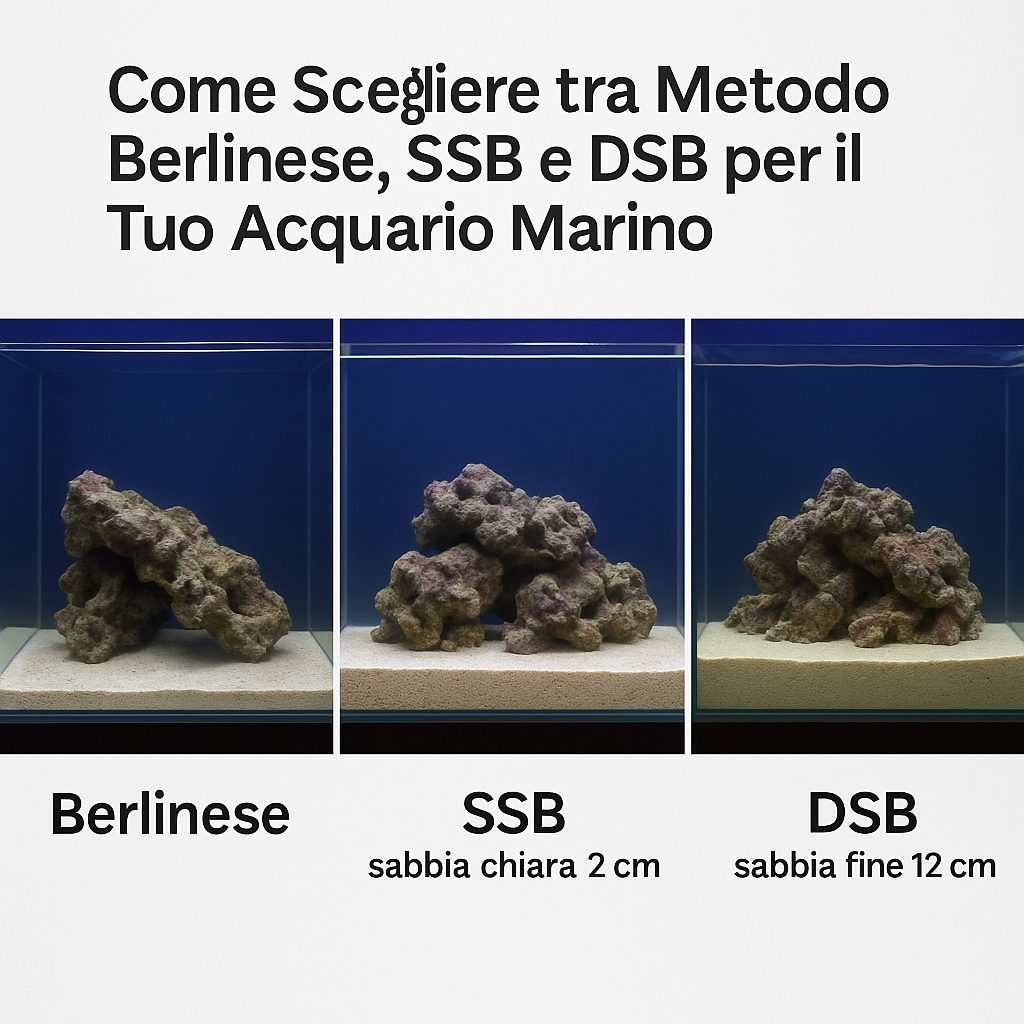
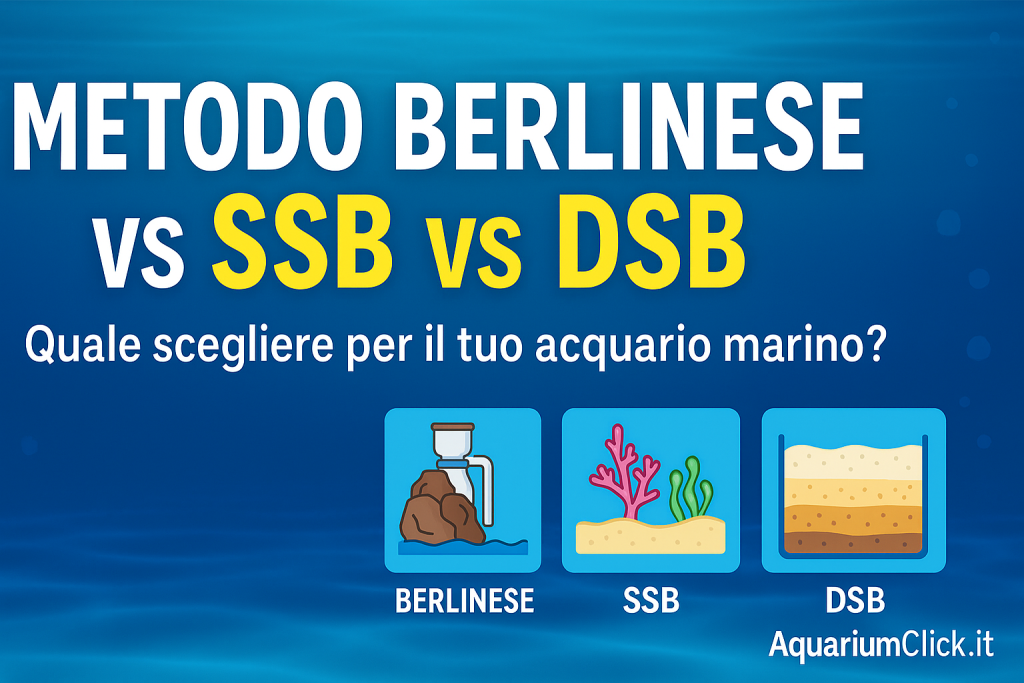 Immagine generata con intelligenza artificiale
 Introduction
Choosing the right methodology of biological filtration and management of the bottom is one of the most important decisions in the design of a marine aquarium, especially if one is aiming at a stable, long-lived and efficient system. The debate between the Berlin Method, the Shallow Sand Bed (SSB) and the Deep Sand Bed (DSB) has been open for years, and each option offers advantages and compromises that deserve to be understood in depth.
This article goes deeper into the three approaches from the scientific and practical point of view, helping you to choose the method most suited to your marine layout.
1. The Berlin Method
What it is
The Berlin method is a technique of marine aquarium management based on three fundamental elements:
- High-quality live rock
- A powerful protein skimmer
- Absence or minimal presence of substrate
Originating in the 1980s in Berlin, it is based on the idea of entrusting almost all the biological filtration to live rock colonised by bacteria, assisted by a skimmer that eliminates the dissolved nutrients.
Characteristics
- Bottom: often bare (bare bottom) or with minimal sand for aesthetic purposes only
- Maintenance: high turbulence and flow to avoid accumulations
- Nutrients: low-nutrient approach (ULNS)
Pros
- Extreme simplicity in the management of nutrients
- Maximum control over cleanliness and the organic load
- Excellent for demanding SPS corals
Cons
- Less surface for denitrifying bacteria
- Sterile or unnatural appearance if not well arranged
- It requires an excellent skimmer and precise water movement
2. SSB – Shallow Sand Bed
What it is
The Shallow Sand Bed calls for a thin bed of sand, generally between 1 and 3 cm, with a mainly aesthetic but also secondary biological function.
Characteristics
- Thickness: 1–3 cm
- Grain size: medium or fine, not subject to rapid compaction
- Usefulness: it houses microfauna, improves chemical stability, offers surface for bacteria
Pros
- Natural appearance
- Additional surface for bacterial colonies
- It does not easily become an accumulator of detritus if well managed
Cons
- Not sufficient to activate deep denitrification
- It needs periodic light siphoning
- It can be lifted by strong pumps if too light
3. DSB – Deep Sand Bed
What it is
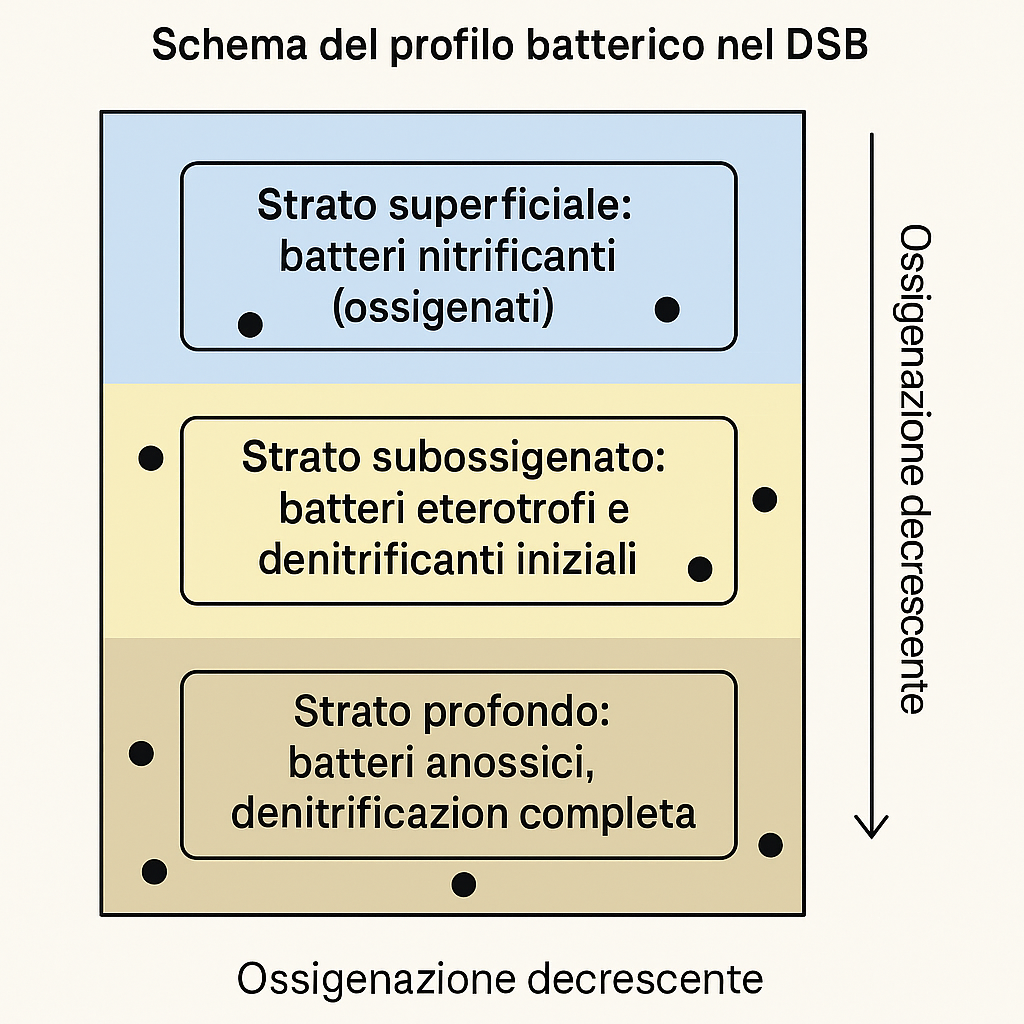
The Deep Sand Bed consists of a deep layer of sand (from 10 to 15 cm) with a fine grain size. It serves to create anoxic zones, in which denitrifying bacteria develop that transform the nitrates (NO₃⁻) into gaseous nitrogen (N₂), completing the nitrogen cycle.
Characteristics
- Thickness: from 10 to 15 cm
- Grain size: 0.05 – 1 mm (fine sand)
- It requires surface movement, but not penetrating
Pros
- Excellent capacity for natural denitrification
- It houses useful microfauna and high biodiversity
- A “closed” and self-sufficient system in the long term
Cons
- It requires space and dedicated design
- It can accumulate toxic substances if disturbed (sulphides)
- Long maturation period (even 6 months)
| Characteristic | Berlin Method | SSB | DSB |
|---|
| Thickness of the bottom | 0–2 cm | 1–3 cm | 10–15 cm |
| Natural denitrification | ❌ | ❌ | ✅ |
| It requires siphoning | Little | Moderate | Only superficial |
| Suited to digging fish | ❌ | ✅ | ❌ |
| Stability over time | High | Medium | High (after maturation) |
| Suited to ULNS (Zeovit) | ✅ | ✅ | ❌ |
| Cost | Low | Low | Medium |
| Care and maintenance | Simple | Medium | Attentive |
4. Comparison between the Methods
| Characteristic | Berlin | SSB (1–3 cm) | DSB (10–15 cm) |
|---|---|---|---|
| Biological filtration | Live rock | Rock + sand | Rock + sand |
| Denitrification | Limited | Almost absent | High |
| Maintenance | High | Medium | Low (if stable) |
| Natural appearance | Low | High | High |
| Risk of accumulations | Low | Medium | High if badly managed |
| Start-up / maturation | Rapid | Fairly rapid | Slow |
| Ideal for | SPS ULNS | Mixed tanks | Natural systems |
5. Which Method to Choose?
If you have an SPS-dominant tank
Prefer the Berlin if:
- You have a high-quality skimmer
- You can guarantee an intense and stable flow
- You use ULNS or Zeovit methods
- For those looking for simplicity, stability, rapid maintenance
- Ideal in ULNS tanks (Zeovit, Triton), frag tanks or pure SPS
- Not suited to wrasses, gobies or digging fish
If you have a mixed or LPS tank
The SSB is optimal for balancing aesthetics, management and biology. It is flexible, adjustable, and integrates well with targeted dosing of nutrients.
- An excellent aesthetic-functional compromise
- Suited to those who want to house a mixed fauna (corals + fish + invertebrates)
- It requires good management of the flow
If you want a natural ecosystem
The DSB is the method closest to natural reefs. It requires time, patience and design, but it offers deep stability and functionality. Ideal in a sump or refugium, but it can also be inserted in the main display if well thought out.
- The optimal choice for those who want maximum biological efficiency
- Ideal in a refugium or in systems with strong nitrate accumulation
- Not advisable for aquarists starting out or in tanks that are not very stable
Conclusion
There is no “best method” in absolute terms. There is the method most suited to your management style, to your tank, to your fauna and to your time.
The Berlin Method offers you responsiveness, control and surgical cleanliness.
The SSB guarantees balance, aesthetics and flexibility.
The DSB, if well managed, is a powerful, stable and silent natural filter.
In any case, the choice must start from a technical consideration, not an aesthetic one. And it must be maintained with consistency over time.
Glossary
- ULNS: Ultra Low Nutrient System – system with very low nutrients
- DSB: Deep Sand Bed – deep sandy bed
- SSB: Shallow Sand Bed – shallow sandy bed
- KH: Carbonate hardness (alkalinity), expressed in dKH
- NO₃⁻: Nitrates
- PO₄³⁻: phosphate
- N₂: Molecular nitrogen (gas)
- Balling: method of replenishing calcium/kh through the dosing of separate liquids
- SPS: small polyp corals (Acropora, Montipora)
- LPS: large polyp corals (Euphyllia, Acanthastrea)
Real Case Studies
400-litre SPS tank – Berlin
- Method: without sand, EpoReef rock + powerful skimmer
- Result: NO₃ < 2 ppm, KH stable at 7.5 dKH
- Interventions: manual balling + activated carbon
300-litre mixed tank – SSB 2 cm
- Methodology: mixed LPS/zoanthus reef + CaribSea sand
- Result: NO₃ 5 ppm, bottom siphoned every 10 days
- Fauna: wrasses, gobies, crustaceans
Connected refugium – DSB 15 cm
- Substrate: sugar-size aragonite + caulerpa + copepods
- Nitrates at the inlet: 20 ppm → outlet: 3–5 ppm
- Maturation time: 3 months
Information boxes
⚠️ Avoid these common mistakes
- Thin DSB: a layer of 4–6 cm is neither SSB nor DSB and risks harmful accumulation
- SSB that is too deep: it favours compaction and stagnation
- Berlin without siphoning: it favours accumulation of PO₄ in the blind spots
🧪 Recommended tests and monitoring
| Parameter | Recommended frequency |
|---|---|
| KH | 2–3 times a week |
| Nitrates (NO₃⁻) | Weekly |
| Phosphates (PO₄³⁻) | Weekly |
| pH | Weekly |
FAQ
1. Can I combine the Berlin Method with a sandy bottom?
Yes, but with care. Many aquarists use a thin layer of sand for aesthetic purposes or to house benthic fauna, while maintaining the Berlin logic. However, this bottom must not exceed 1–2 cm so as not to interfere with the philosophy of the method.
2. Is the DSB really self-sufficient or must it be supplemented with other filtration?
A well-matured DSB can manage denitrification on its own, but it must be supported by moderate water movement, by well-arranged rocks and by an efficient skimmer for protein removal. It is not a “zero technology” system, but it is less dependent on external interventions.
3. How long does it take for a DSB to start really working?
In optimal conditions, the sandy bed starts to denitrify in a stable way between 4 and 6 months (in some cases even 1 year). During this period, it is important not to disturb the substrate, to avoid deep siphoning and to let the anaerobic microbiome develop.
4. Is the SSB method also suited to SPS corals?
Yes, provided that the system is well ventilated, with good flow and that organic accumulations are avoided. The thin substrate does not offer the same denitrifying power as the DSB, but if well maintained it is compatible with demanding corals.
5. What is the ideal grain size for SSB and DSB?
- SSB: 0.8–1.2 mm, fine but not impalpable sand (avoids compaction)
- DSB: 0.05–0.5 mm, very fine sand (oolitic or “sugar-size” aragonite) to favour anoxic zones
6. Can I use strong pumps with a DSB?
Not directly on the bottom. The DSB does not tolerate excessive turbulence that lifts sediments and oxygenates deep layers. The flow must be indirect, laminar or controlled, never pointed against the substrate.
7. Is the Berlin method still current in 2025?
Absolutely yes. It is still the reference method for high-performance SPS tanks, compatible with modern technologies (Balling, ICP, pH control) and with minimalist layouts. Its flexibility and responsiveness still make it much appreciated.
8. How often do I have to siphon the sand in an SSB?
Every 7–10 days, limiting yourself to the surface layers. Avoid penetrating too deeply so as not to release toxins or alter the microenvironments already formed.
9. In case of a mistake, which method is easier to “correct”?
The Berlin method, thanks to its structural simplicity, is the easiest to restore. DSB and SSB, if compromised (compaction, accumulations, sulphides), can require drastic interventions or partial resets.
10. Can I move from one method to the other without emptying everything?
It is possible, but with caution. For example:
- From Berlin to SSB: add sand gradually and monitor nutrients
- From SSB to DSB: difficult, because the depth must be created right from the start
- From DSB to Berlin: it requires complete removal and a biological reset
11. Do I always have to use live sand for SSB or DSB?
No, but it speeds up bacterial colonisation. Inert sands too can become “live” with time.
12. What happens if I remove or mix the DSB?
It can release sulphides and toxic substances. If you have to remove it, do it in small sections over time, never all at once.
13. Does the Berlin method necessarily require live rock?
Today dead or synthetic rock is often used (EpoReef, RealReef), but more time is needed to mature and bacteria inoculated externally.
14. Which is the most economical method in the long term?
The Berlin tends to be more economical if one already has excellent live rock and a skimmer. The DSB requires less technology but more space and time.
Share questo articolo:
Text reviewed by a human editor before publication. Editor responsible: Francesco Avezzano, a journalist registered with the Order of Journalists of Campania. How I use artificial intelligence