The Nitrogen Cycle in the Aquarium

You have just finished setting up the tank. Filter switched on, temperature right, decorations arranged. You add the fish after two days because somebody told you to wait a bit. Everything seems calm. Then, after a week, the fish start staying still in a corner. One dies. A second one. You do not understand why: the water looks clean, there is nothing visible. You buy a test kit, you measure and you find yourself faced with numbers you do not know how to read.
What is happening has a precise name: your tank does not yet have a working nitrogen cycle. And until it has one, no fish is safe.
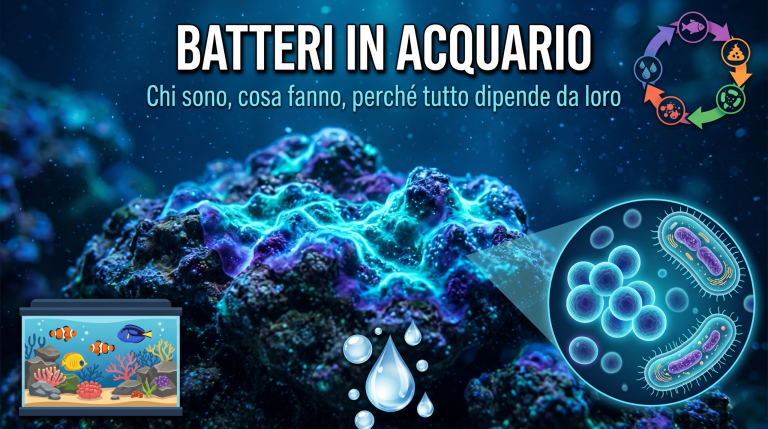
The nitrogen cycle in the aquarium is the biological process that transforms the nitrogenous waste produced by your fish into progressively less toxic compounds. It is managed almost entirely by the bacteria we talked about in a dedicated article. Without it, ammonia accumulates to lethal levels within days. With it, the tank becomes a biological system capable of managing itself, provided you do not disturb it with wrong interventions.
In this article you find everything needed to understand it properly: not only the three arrows of the drawing that is found on every forum, but the chemistry behind it, the dynamics that change according to the type of tank, the mistakes that block it and the signals that tell you when something is not right. With the distinctions that most online guides ignore completely.
What the nitrogen cycle is and how it works in a closed system
In nature, nitrogen is one of the most abundant and most cycled elements of the ecosystem. Every living organism uses it to build proteins. When an organism dies, or when it expels metabolic waste, the nitrogen returns to the environment in different forms and is processed by microbial communities that transform it, put it back into the cycle, make it available again.
In a river, in a lake, in an ocean, this process takes place over volumes so large and with microbial communities so diversified that it rarely creates problems. In a 100-litre aquarium, the same process takes place in a restricted space, with a concentrated biological load and without the natural turnover of the open environment. The result is that every accumulation makes itself felt rapidly, every imbalance is amplified, every management error produces consequences in hours instead of in weeks.
The nitrogen cycle in the aquarium is therefore the biological response adapted to this closed system: a chain of chemical transformations carried out by specialised bacteria that convert nitrogen from the most toxic forms to the least dangerous ones, continuously and silently.
The starting point: everything begins with waste
Every fish that eats produces ammonia as a waste product of protein metabolism. It expels it mainly through the gills, in the form of dissolved ammonia (NH₃) or ammonium ion (NH₄⁺). The proportion between the two forms depends on the pH and the temperature of the water: at high pH and high temperature, the free form NH₃ dominates and that is the most toxic one. At lower pH, the balance shifts towards NH₄⁺, less aggressive but still problematic at high concentrations.
To this ammonia is added that produced by the decomposition of uneaten food, faeces, dead organisms, decomposing plant leaves. In a tank without active nitrifying bacteria, all this accumulates. At 0.5 mg/L of free ammonia, gill damage in fish is already under way. At 1 mg/L, mortality is probable within a few hours.
This is the reason why a tank without an established biological cycle is a lethal environment for any fish that is not extremely hardy.
The three transformations of the cycle
The nitrogen cycle is articulated in three main transformations, each managed by different bacterial groups with different requirements. Understanding each step, not just knowing the names, is what makes it possible to understand why certain problems appear and how to solve them.
First transformation: from ammonia to nitrite
Ammonium-oxidising bacteria (AOB and AOA) convert ammonia into nitrite (NO₂⁻). This reaction is aerobic: it consumes dissolved oxygen and requires the filter to be well oxygenated. It also produces hydrogen ions (H⁺) as a by-product, which gradually lowers the pH of the system over time if the alkalinity is not managed.
Nitrite too is toxic. It interferes with the haemoglobin of fish, preventing it from transporting oxygen, causing a form of asphyxia even in perfectly oxygenated water. It is less acute than ammonia but no less dangerous, especially in prolonged exposures.
In systems in the start-up phase, the nitrite peak always arrives after the ammonia peak: first the bacteria that process ammonia (AOB) settle in, then those that process nitrite. This time lag is normal but represents the most critical moment of the entire maturation process.
Second transformation: from nitrite to nitrate
Nitrite-oxidising bacteria (NOB), mainly of the genus Nitrospira, convert nitrite into nitrate (NO₃⁻). Nitrate is much less toxic than its precursors. Most freshwater fish tolerate concentrations up to 50 mg/L without visible acute effects. In marine aquariums with corals, especially SPS, the target is much lower: often below 5-10 mg/L, because the polyps are sensitive even to minimal variations.
Nitrate accumulates in the system over time. It does not disappear on its own: it is removed by periodic water changes, absorbed by plants as nitrogenous nourishment, or converted into gaseous nitrogen by denitrifying bacteria in zones without oxygen. This last process, denitrification, is the final step of the complete cycle.
Third transformation: from nitrate to gaseous nitrogen
Denitrification is the anaerobic process that closes the nitrogen cycle. Denitrifying bacteria, in conditions of very low or absent oxygen, use nitrate as an electron acceptor in place of oxygen and reduce it to gaseous nitrogen (N₂), which leaves the water and disperses into the air.
This process takes place in the anoxic zones of the system: the deep layers of the substrate, the interior of the live rock in marine systems, deep sand beds (DSB), dedicated denitrifying reactors. In a well-planted freshwater aquarium, the plants absorb nitrates directly as nourishment, in fact carrying out an analogous function. In a marine system with abundant live rock, denitrification takes place naturally inside the porous structure of the rocks themselves.
In systems without active denitrification or abundant plants, nitrates accumulate indefinitely and must be removed mechanically with water changes. It is not a mistake: it is simply an incomplete system, which requires more active management.
How it is measured and what the numbers mean
Managing the nitrogen cycle without measuring the parameters is like driving blindfolded. Test kits are the minimum indispensable instrument, not an accessory for advanced enthusiasts.
Ammonia: the most critical parameter
Total ammonia comprises both the free form (NH₃) and the ammonium ion (NH₄⁺). Standard kits measure the total. To know the actually toxic share of NH₃, one must also know pH and temperature and apply the chemical equilibrium relation between the two forms. In practice: at pH 7 and 25°C, about 0.6% of total ammonia is in free form. At pH 8 and 28°C, the percentage rises to about 6%. The same concentration of total ammonia is therefore much more dangerous in a marine aquarium at high pH than in a slightly acidic freshwater aquarium.
In a tank with a working biological cycle, ammonia must be at zero or at the detectable limit. Any measurable value is a signal that something is not working.
Nitrite: the peak that frightens beginners
Nitrite inevitably rises during the start-up phase, after the ammonia peak. Seeing it rise is normal and must not be fought with massive water changes, which also dilute the bacteria that are forming. In an established tank, nitrite must be at zero. If it appears in an already mature system, it is the signal of an event that has compromised the NOB bacteria: aggressive cleaning of the filter, antibiotics, abrupt thermal variation, interruption of the pump.
Nitrate: the parameter to keep under control over time
Nitrate is not an acute emergency but a chronic problem if not managed. In fresh water with common fish, below 50 mg/L is generally acceptable. Below 20 mg/L is better. In tanks with shrimp, below 10 mg/L. In reefs with hard corals, below 5 mg/L is the target. Chronically high values, even without dead fish, are associated with immunosuppression, reduced fertility, greater susceptibility to diseases and, in marine systems, visible coral stress.
The maturation phase: what happens week by week
Every new tank must go through a period of biological maturation before it can house fish safely. There is no way of skipping it altogether: it can be accelerated, but not eliminated. Knowing the phases helps to understand whether what you see is normal or not.
The first two weeks: ammonia and heterotrophs
In the very first days, with a source of ammonia present (food, decomposing organic material, artificially added ammonia), heterotrophic bacteria multiply rapidly. The water may become milky: it is a heterotrophic bacterial bloom, normal and temporary. Ammonia rises because the bacteria that process it are not yet present in sufficient numbers.
From the second to the fourth week: nitrites rise
The first AOB bacteria settle in and start converting ammonia into nitrite. Ammonia begins to fall. Nitrites rise, sometimes to very high levels. It is the signal that the first stage of nitrification is stabilising. The NOB bacteria are slower to settle in: they arrive afterwards.
From the fourth to the sixth week: the cycle closes
The NOB bacteria settle in and start converting nitrite into nitrate. Nitrites fall. Nitrates rise, a sign that the whole chain is working. When ammonia and nitrite both return to zero within 24 hours of a standard addition of ammonia, the cycle is completed. The tank is ready.
These times apply to tropical fresh water at 25-27°C. In cold systems the times lengthen considerably. In marine systems they lengthen to 6-8 weeks. With a bacterial inoculum from a mature tank or quality live rock, the times shorten drastically.
The nitrogen cycle in the tropical freshwater aquarium
Tropical fresh water is the most studied context and the one in which the nitrogen cycle behaves in the most predictable way. Temperatures between 24°C and 28°C fall within the thermal optimum for the main nitrifying bacteria. A pH between 6.5 and 7.5 is compatible with efficient nitrification. The oxygenation guaranteed by pumps and filters is generally adequate.
In a planted aquarium, the plants significantly change the dynamics of the cycle. They absorb ammonia and nitrates directly as nitrogenous nourishment. In a densely planted system with injected CO₂ and calibrated lighting, this function can be so efficient as to keep nitrates close to zero even with infrequent water changes. Plants do not replace the bacteria: they work in parallel, competing for the same nitrogenous resources.
A common mistake in tropical fresh water is adding too many fish too quickly after maturation. The biological filter adapts to the load it has always managed: a rapid increase in the number of fish can temporarily exceed the bacterial capacity of the filter, causing ammonia peaks even in mature tanks. Gradual addition, one or two fish at a time with a few weeks’ interval, leaves the microbiome the time to expand proportionally.
The nitrogen cycle in the cold-water aquarium, garden ponds and pond systems
Temperature is the variable that changes everything in cold systems. Nitrifying bacteria have a thermal optimum between 25°C and 30°C. Below 15°C they slow down significantly. Below 10°C nitrification becomes almost negligible. Below 4°C it stops.
In a garden pond during the winter, the nitrogen cycle is in fact suspended. The fish survive because their metabolism slows down just as much: a cyprinid in torpor produces minimal quantities of ammonia, little enough not to create problems even without active bacteria. The system holds up not because it works biologically, but because the load is negligible.
The critical moment is spring. The fish wake up and start feeding again before the bacteria have had the time to reconstitute themselves after the winter mortality. The organic load rises before the biological capacity of the filter is restored. This time lag is the cause of many spring losses in garden ponds. The correct protocol calls for waiting until the temperature is stable above 10°C before resuming feeding, for doing it gradually and for monitoring ammonia and nitrite in the first weeks.
Commercial bacterial products formulated for tropical systems work badly in a pond at 10°C. The strains selected for 25-28°C do not colonise effectively at low temperatures. For cold systems, the best inoculum remains biological material from a system already running in the same thermal range, or specific products formulated with psychrotolerant strains.
The nitrogen cycle in the tropical marine aquarium
The tropical marine system is the most complex and the most demanding. Marine nitrification is dominated by ammonium-oxidising archaea (AOA) in mature systems, not by the AOB bacteria that dominate in fresh water. This distinction has direct practical consequences: commercial bacterial products, almost all formulated with AOB strains, have a more limited effect in advanced marine systems than one would expect.
The best way to start the biological cycle in a marine tank is inoculation with quality live rock. Live rock already brings functional bacterial communities adapted to salt water, including the AOA. With abundant live rock of good quality, the cycle can be completed in a week instead of in months.
In reef systems with SPS corals, the management of the nitrogen cycle reaches the maximum level of precision. The margins of tolerance are minimal: ammonia and nitrite must be zero, nitrates below 5-10 mg/L, phosphates below 0.05-0.1 mg/L. In these systems biological denitrification through live rock, DSB or dedicated reactors is not an optional extra: it is necessary in order to keep nitrates under control without continuous water changes that would destabilise the parameters.
The Zeovit protocol, developed by Korallen-Zucht, represents the most sophisticated approach to the management of the nitrogen cycle in a reef. It is based on the use of zeolite as a substrate for specific bacteria that consume organic nitrogen and phosphorus in a controlled way, replicating the oligotrophic conditions of the natural coral reef. It is not a system for those starting out: it requires deep understanding of the biological mechanisms and daily attention to the signals of the corals.
The nitrogen cycle in the Mediterranean marine aquarium
The Mediterranean marine tank is the system most ignored by the aquarium literature on the nitrogen cycle, and yet it presents the most particular dynamics. The higher salinity compared with the open ocean (37-38 ppt in Italian coastal waters), the significant seasonal thermal swings (14-16°C in winter, 26-28°C in summer) and the ionic composition different from that of the Atlantic create conditions that select bacterial communities different from those of tropical systems.
In summer, the critical issue is oxygenation. At 28°C sea water contains about 7.2 mg/L of O₂ compared with 9.8 mg/L at 15°C. Nitrifying bacteria are strict aerobes: below 5 mg/L they slow down, below 2 mg/L they stop. In a poorly oxygenated Mediterranean system during the hot months, the biological filter can lose efficiency precisely when the organic load is at its maximum.
In winter, nitrification slows down with the temperature. But the metabolism of the inhabitants also slows down proportionally: octopuses, blennies and crabs produce less waste when the temperature falls. The system readapts seasonally, provided one does not intervene with drastic changes during the transitions.
Commercial bacterial products formulated for tropical systems work badly in a Mediterranean one, especially outside the warm season. The best inoculum for a Mediterranean system is always biological material from a system already running in the same thermal range and at the same salinity.
How to manage the nitrogen cycle: the practices that work
How to accelerate maturation
The most effective method is direct inoculation: filter material from a mature tank, rocks already colonised, substrate taken from a working system. A bacterial community that is already functioning is transferred directly, reducing the times from weeks to days. In a marine tank, quality live rock is the most complete inoculum available.
Commercial bacterial products with live bacteria (Dr. Tim’s One and Only, Fritz TurboStart, Modern Reef Bio Bac and others) accelerate the cycle measurably, but they require an immediate source of ammonia in order to be effective. Dosing them in a tank without available nourishment is useless: the bacteria die within days without a substrate to metabolise.
The optimal temperature for maturation is 25-27°C. Below 20°C the times lengthen significantly. Raising the temperature of the tank during the start-up phase, within the limits compatible with the organisms present, is a legitimate practice for accelerating the process.
How not to block the cycle during maturation
The massive water change during maturation is one of the most common mistakes. When the nitrites rise, the instinctive reaction is to change all or nearly all of it. This dilutes the nitrites but also dilutes the bacteria that are forming, slowing down or zeroing the process. During maturation, water changes are to be limited to emergency cases (nitrites above 5 mg/L with fish present) and never beyond 30%.
UV lamps switched on during maturation kill the bacteria in planktonic form that colonise the new surfaces. Better to keep them off until the cycle is completed.
Anti-chlorine products are to be used always on every top-up water coming from the tap. Chlorine is bactericidal and a single untreated top-up is enough to damage the biofilm that is forming.
How to maintain the cycle in a mature tank
The main rule is to distribute the maintenance operations over time. Water change this week, cleaning of the filter next week, siphoning of the bottom the week after. Doing everything together in a single session removes too much bacterial biomass at the same time.
The biological filter is rinsed exclusively with water taken from the tank, never with tap water. The correct frequency is monthly or every two months according to the load, not weekly. If the filter has several compartments, one compartment is cleaned at a time at least two weeks apart from the other.
Denitrifying products: when they are needed and when they are not
On the market there are various solutions for managing nitrates biologically, besides simple water changes. They make sense in systems with a high load, in reefs where nitrates must stay extremely low or in tanks where frequent water changes are difficult to manage.
Biopellets are spheres of biodegradable polymer that supply organic carbon to heterotrophic bacteria, stimulating a process of carbon-mediated denitrification. They require a dedicated reactor with strong flow and an efficient protein skimmer to remove the bacterial biomass produced. They work well in reefs, but they require calibration: too many biopellets can cause drops in oxygen and destabilise the parameters.
Vodka dosing and the dosing of acetic acid follow the same principle as biopellets: supplying organic carbon to heterotrophic bacteria in order to stimulate denitrification. They are inexpensive but they require extreme attention to the dosage. Errors in excess cause massive bacterial blooms, drops in oxygen and mortality within a few hours.
Denitrifying reactors of the sulphur or anoxic-chamber type are more controllable solutions but also more complex to install and maintain. Suited to advanced systems where the management of nitrate is critical.
Denitrifying substrates such as the Deep Sand Bed (DSB) work passively: the deep sand creates natural anoxic zones where the denitrifying bacteria work without external intervention. They require years to stabilise fully but then they work without maintenance. The main risk is the collapse of the DSB after years, with a massive release of sulphides: a rare event but devastating if not managed.
Common problems and solutions
Ammonia that does not fall after weeks
If ammonia does not fall after three weeks of maturation, the most probable causes are: temperature too low (below 20°C nitrification slows down a great deal), pH too low (below 6.5 the nitrifiers work badly), source of ammonia exhausted (the bacteria have no nourishment), residual chlorine in untreated top-up water. Check one parameter at a time. Temperature is the most frequent cause and the one least controlled by beginners.
Nitrite peak that does not fall
Nitrite that rises and stays high for more than three weeks indicates that the NOB are struggling to settle in. The most common causes are: insufficient oxygenation (the NOB are the most sensitive to drops in O₂), unstable pH, inadequate temperature. Increase the aeration, stabilise the pH with an adequate buffer, bring the temperature to 26°C if there are no contraindications.
Nitrates that rise too rapidly
If nitrates rise quickly despite regular water changes, the system has an organic load greater than its capacity to dispose of it. The solutions are: reducing the number of fish or the frequency of feeding, increasing the frequency of water changes, adding fast-growing plants, considering the introduction of a denitrifying system.
Ammonia that reappears in a mature tank
In a tank with a biological cycle that has been stable for months, the sudden appearance of ammonia is always the warning sign of an event traumatic for the microbiome. The most common causes: aggressive cleaning of the filter, interruption of the pump for more than 6-8 hours, antibiotic treatment in the main tank, massive addition of fish, abrupt thermal variation. Identify the cause, do a 25% water change, reduce the feeding and monitor every day.
Nitrites that appear after a pharmacological treatment
Antibiotics and many antiparasitics damage the beneficial bacteria as well as the pathogenic ones. After a treatment in the main tank, the re-emergence of nitrites is almost inevitable. The correct response is: dosing starter bacteria with live bacteria, temporarily reducing the load of the tank, avoiding further interventions for at least two weeks and monitoring daily. Pharmacological treatments should always be carried out in a separate quarantine tank precisely in order to avoid this problem.
Conclusion
The nitrogen cycle in the aquarium is not a concept to be studied once and then forgotten. It is a living process that changes with time, with the seasons, with the type of system you manage. A cycle that works in summer can show signs of slowing down in winter in a pond. A cycle that is solid in a tropical freshwater tank requires completely different adaptations in a Mediterranean reef.
Deep understanding of this process is what separates the aquarist who reacts to crises from the one who prevents them. It is not a matter of monitoring numbers obsessively: it is a matter of understanding what those numbers are saying about the biological system you have built. Ammonia that rises is not a chemical problem to be solved with a product. It is a biological message that asks to be interpreted.
Managing a tank well means managing the nitrogen cycle well. Everything else, filters, lighting, feeding, comes afterwards.
Practical boxes
Box 1: How to start the biological cycle without fish
Material needed: pure ammonia without surfactants (check that it does not foam by shaking the bottle), test kits for ammonia, nitrite and nitrate, bacterial product with live bacteria. Bring the ammonia to 2-4 mg/L on the first day and dose the bacterial product straight away. On the following days keep the ammonia between 1 and 4 mg/L, adding more when it falls below 1. Do not do water changes during this phase. Between the second and the third week the nitrites will appear: it is the signal that the process is working. Between the fourth and the sixth week the nitrites will fall and the nitrates will rise. When ammonia and nitrite both return to zero within 24 hours of a standard addition, the cycle is completed. Before adding the fish, do a 50% change to lower the accumulated nitrates.
Box 2: How to read the water tests during maturation
In the first two weeks you will see high ammonia and nitrites at zero: normal. From the second to the fourth week you will see ammonia falling and nitrites rising: the first stage is stabilising. From the fourth week onwards you will see nitrites falling and nitrates appearing: the second stage is settling in. When ammonia and nitrite are both at zero with nitrates present, the cycle is complete. If the ammonia does not fall after three weeks, check temperature and pH before doing anything else.
Box 3: Management of the cycle in seasonal systems
For ponds and garden ponds: stop feeding when the temperature falls below 10°C. Resume only when the temperature is stable above 10°C for at least a week. In the first two weeks of spring feed once a day with reduced quantities and monitor ammonia every 2-3 days. If the values rise, reduce or stop temporarily. Starter bacteria for low temperatures are to be dosed only when the temperature exceeds 8°C: below this threshold colonisation does not take place anyway. Size the filter for the summer peak load, not for the winter one.
Box 4: Warning signals not to be ignored
Detectable ammonia in a mature tank: something has compromised the filter, investigate before intervening. Nitrites that reappear after months of stability: recent traumatic event on the microbiome, look for the cause. Nitrates that rise more quickly than usual with the same load: denitrification has been reduced or the organic load has increased. Fish with respiratory symptoms in oxygenated water: ammonia or nitrite peak under way, test the parameters immediately. Persistent milky turbidity beyond the first weeks: heterotrophic bloom from excessive organic load, reduce the feeding.
FAQ
What is the nitrogen cycle in the aquarium in simple words?
It is the biological process through which bacteria transform the nitrogenous waste of fish (mainly ammonia) into progressively less toxic compounds. First the ammonia becomes nitrite, then the nitrite becomes nitrate. In advanced systems the nitrate is then converted into gaseous nitrogen by denitrifying bacteria.
How long does it take to complete the nitrogen cycle in a new tank?
In tropical fresh water at 25-27°C, between 4 and 6 weeks without a bacterial inoculum. With biological material from a mature tank or quality live rock, it can come down to 1-2 weeks. In marine systems the times are 6-8 weeks without an inoculum. In cold systems the times lengthen in proportion to the temperature.
Can I add fish before the cycle is completed?
It is not advisable. The peaks of ammonia and nitrite during maturation are potentially lethal. If you are forced to do it, use very hardy fish, monitor every day, do frequent water changes to keep the ammonia below 0.25 mg/L and do not add other fish until the cycle is complete.
Why does ammonia rise again in an already established tank?
Because something has damaged the nitrifying bacteria. The most common causes: aggressive cleaning of the filter, interruption of the pump for many hours, antibiotic treatment in the main tank, massive addition of fish, abrupt thermal variation. Identify the cause before intervening.
Why do nitrites rise during maturation?
Because the AOB bacteria (which convert ammonia into nitrite) settle in before the NOB bacteria (which convert nitrite into nitrate). The nitrite peak is normal and expected: it signals that the first stage of nitrification is working. It falls when the NOB stabilise, generally between the fourth and the sixth week.
Do I have to change the water during maturation?
No, or as little as possible. Water changes during maturation dilute the bacteria that are forming and slow down the process. They are done only in case of emergency (ammonia or nitrites at dangerous levels with fish present) and never beyond 30%.
Do bacterial products in a bottle really work?
Yes, if used correctly. They accelerate the cycle measurably, but they require a source of ammonia to be present. Dosing them in a tank without available ammonia is useless: the bacteria die without nourishment. The correct sequence is: ammonia first, bacteria afterwards or simultaneously.
How much nitrate is acceptable in an aquarium?
In fresh water with common fish, below 50 mg/L is acceptable, below 20 mg/L is better. In tanks with shrimp, below 10 mg/L. In reefs with soft corals, below 25 mg/L. In reefs with SPS corals, below 5-10 mg/L.
How are nitrates lowered biologically?
With denitrification: anaerobic bacteria that convert nitrate into gaseous nitrogen in zones without oxygen. It takes place naturally in live rock, in the DSB, in dedicated anoxic filters. It can be stimulated with biopellets, vodka dosing or denitrifying reactors. In fresh water, fast-growing plants absorb nitrates directly.
Is denitrification necessary in all systems?
No. In fresh water with regular water changes and a moderate load, the water changes remove the nitrates sufficiently. Biological denitrification becomes necessary in reefs where the nitrates must stay very low, in systems with a high load or where frequent water changes are difficult to manage.
Does the nitrogen cycle work the same way in fresh water and marine water?
No. The bacterial strains are different. In marine water, the ammonium-oxidising archaea (AOA) dominate in mature systems, whereas in fresh water the AOB bacteria dominate. The maturation times are longer in marine systems. Starter products formulated for fresh water work less well in marine systems.
What happens to the nitrogen cycle in winter in a garden pond?
It slows down drastically and below 4°C it stops almost completely. The fish survive because their metabolism also slows down, producing negligible quantities of ammonia. The most critical moment is spring, when the fish wake up before the bacteria have reconstituted themselves.
Does the UV lamp interfere with the nitrogen cycle?
Not directly: the bacteria of the biological filter do not pass through the UV lamp. However continuous use reduces the planktonic bacterial load that contributes to the colonisation of new surfaces. Better to keep it off during maturation and to use it intermittently afterwards.
Do water changes damage the nitrogen cycle?
No, if carried out correctly. The bacteria live in the biofilm of the filter and on the surfaces, not in the water you remove. The only risk is using non-dechlorinated tap water, which damages the biofilm on contact. Always dechlorinate the new water before adding it.
How long do the bacteria survive if the pump stops?
Aerobic nitrifying bacteria go into stress within 4-6 hours without oxygen. After 12-24 hours the mortality is significant. After 48 hours the filter may have lost a large part of its biological capacity. After a prolonged interruption, dose starter bacteria and monitor the parameters for two weeks.
Can I accelerate the cycle by raising the temperature?
Yes, within reasonable limits. Bringing the temperature to 27-28°C during maturation accelerates the bacterial metabolism and reduces the times of the cycle. It is to be done only if there are no heat-sensitive organisms already present in the tank.
Can the nitrogen cycle be blocked in an already mature tank?
Yes. The most common events that compromise it are: aggressive cleaning of the filter, antibiotic treatments in the main tank, prolonged interruptions of the pump, abrupt thermal variations, massive addition of fish that exceeds the biological capacity of the filter.
What are biopellets and how do they act on the nitrogen cycle?
They are spheres of biodegradable polymer that supply organic carbon to heterotrophic bacteria, stimulating a process of carbon-mediated denitrification. They require a dedicated reactor and an efficient protein skimmer. They work well in reefs for lowering nitrates and phosphates, but they require careful calibration.
Is vodka dosing safe?
It works but it has narrow margins of error. It supplies organic carbon to heterotrophic bacteria, stimulating denitrification, like biopellets. Errors in excess cause massive bacterial blooms, drops in oxygen and rapid mortality. It is not advisable for those who do not already have experience in managing the parameters in a reef.
Is the nitrogen cycle the same for shrimp and fish?
The process is the same but shrimp are much more sensitive to peaks of ammonia and nitrite. A tank for caridina requires a more stable and solid biological cycle than a tank for common fish. The margins of tolerance are lower and every fluctuation makes itself felt sooner.
Can I do the cycle without adding ammonia artificially?
Yes. One can use excess food, a raw prawn that decomposes, or very hardy fish (fish-in cycling). These alternatives are less controllable than pure ammonia but they produce the same result. Pure ammonia is preferable because it allows the concentration to be controlled exactly.
Glossary
Ammonia (NH₃): toxic nitrogenous compound produced by the protein metabolism of aquatic organisms. The free non-ionised form is more toxic at high pH and high temperature. The first product to be eliminated in the nitrogen cycle.
Ammonification: process of decomposition of nitrogenous organic matter into ammonia, carried out by heterotrophic decomposing bacteria. It is the starting point of the nitrogen cycle.
AOA (Ammonia-Oxidizing Archaea): archaea that oxidise ammonia to nitrite. Dominant in mature marine systems and in oligotrophic environments. Different from AOB bacteria in genetics and ecological niche.
AOB (Ammonia-Oxidizing Bacteria): bacteria that oxidise ammonia to nitrite. Main genera: Nitrosomonas, Nitrosospira. More abundant in freshwater systems with a high concentration of ammonia.
Gaseous nitrogen (N₂): final product of denitrification. Inert gas that leaves the water and disperses into the air. It represents the definitive removal of nitrogen from the system.
Biopellet: spheres of biodegradable polymer used in reefs to stimulate denitrification mediated by organic carbon. They require a dedicated reactor and an efficient protein skimmer.
COMAMMOX (Complete Ammonia Oxidizers): bacteria of the genus Nitrospira capable of oxidising ammonia directly to nitrate in a single process. Discovered in 2015, probably present in mature biological filters.
Denitrification: anaerobic process of conversion of nitrate into gaseous nitrogen. Carried out by denitrifying bacteria in anoxic zones. It closes the nitrogen cycle by removing nitrogen from the system.
DSB (Deep Sand Bed): substrate of fine sand with a depth of at least 10-15 cm. It creates natural anoxic zones favourable to passive biological denitrification.
Fishless cycling: method of starting the biological cycle without fish, using pure ammonia as a source of nourishment for the nitrifying bacteria. The safest and most controllable method.
Fish-in cycling: method of starting the biological cycle with fish already present. Historic but problematic: it exposes the fish to potentially lethal peaks of ammonia and nitrite.
Ammonium ion (NH₄⁺): ionised form of ammonia, less toxic than the free form NH₃. It dominates at low pH. Standard tests measure total ammonia (NH₃ + NH₄⁺).
Nitrate (NO₃⁻): final product of nitrification. Relatively little toxic for fish. It accumulates over time and is removed with water changes, plants or denitrification.
Nitrite (NO₂⁻): intermediate product of nitrification. Toxic because it interferes with the transport of oxygen in haemoglobin. Inevitable peak during biological maturation.
Nitrobacter: nitrite-oxidising bacterial genus. It dominates in laboratory conditions and at high concentrations of nitrite, but it proves less competitive in mature filters than Nitrospira.
Nitrification: aerobic process of oxidation of ammonia to nitrite and then to nitrate. Carried out by two distinct groups of nitrifying bacteria and archaea. Fundamental for the management of nitrogen in closed systems.
Nitrospira: nitrite-oxidising bacterial genus dominant in mature biological filters. Some species are also COMAMMOX, capable of completing the entire nitrification on their own.
NOB (Nitrite-Oxidizing Bacteria): bacteria that oxidise nitrite to nitrate. Main genus in mature filters: Nitrospira. Slower than the AOB in settling in, more sensitive to drops in oxygenation.
Nitrosation: phase of nitrification in which ammonia is converted into nitrite by the AOB bacteria and by the AOA archaea.
Psychrotolerant: organism capable of growing and metabolising at low temperatures (0-15°C). Psychrotolerant bacteria dominate in cold systems and in ponds during the winter months.
Vodka dosing: denitrification technique that involves the controlled dosing of ethanol (vodka or pure ethanol) in order to supply organic carbon to heterotrophic bacteria and stimulate the reduction of nitrates. Effective but with narrow margins of error.
Zeovit: protocol for the management of the nitrogen cycle in reefs based on the use of zeolite as a bacterial substrate, combined with specific products in order to replicate the oligotrophic conditions of the natural coral reef.
Share questo articolo:
Text reviewed by a human editor before publication. Editor responsible: Francesco Avezzano, a journalist registered with the Order of Journalists of Campania. How I use artificial intelligence