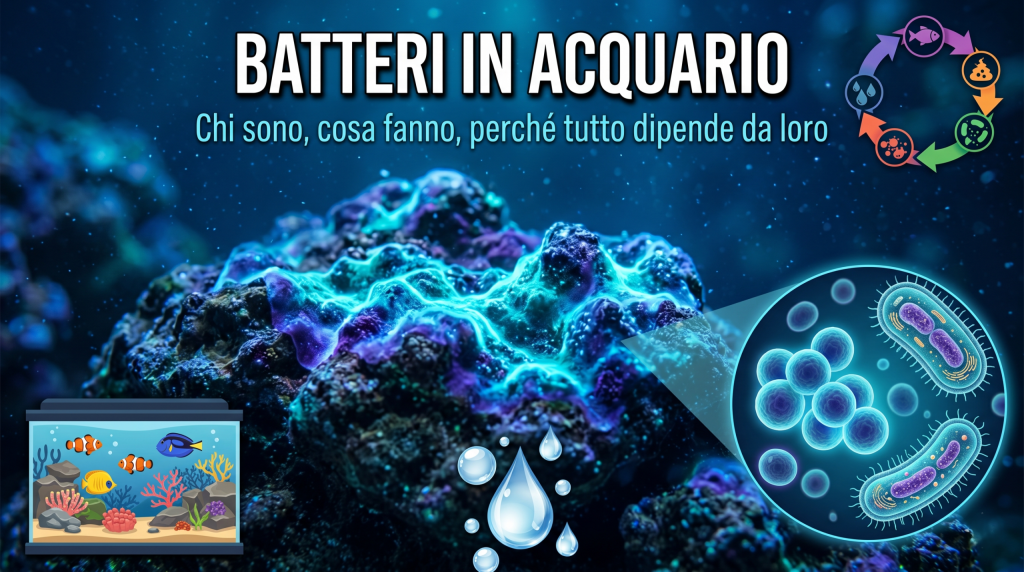
Bacteria in the aquarium: a complete guide to the biological cycle
Three weeks ago you started up the tank. You did everything: substrate, decorations, filter switched on, temperature set. You waited a few days before adding the fish, as the shop had told you. Then you bought the test kit, you measured the ammonia and you saw a number you were not expecting. You reread the instructions of the bacterial product you dosed on the first day. You did a 30% water change. The next day, the ammonia was still there.
This scenario is familiar to anyone who has ever started a tank without serious guidance. And it is not your fault that you did not know what was happening, because most of the information available online on the subject is written by people who have never really understood the biology of an aquarium. There is an army of content generated in five minutes, recycled from recycled sources, published on blogs that have been copying each other for years. Bacteria in the aquarium are treated as a textbook notion: two paragraphs on the nitrogen cycle, a list of products, some generic advice. The end.
It does not work like that. Not in a tank.
The reality is that bacteria are not a technical detail to be managed during start-up and then forgotten. They are the biological heart of every closed aquatic system. They are the reason why a tank stabilises or collapses, why the parameters hold or go haywire, why the fish are well or suffer for no apparent reason. Understanding how they work, where they live, what they eat, what kills them and how they change according to the type of aquarium you manage: this is what makes the difference between an aquarist who chases emergencies and one who prevents them.
In this article you will find everything you need to know about bacteria in the aquarium, without simplifications, with the distinctions that really count: because a tropical freshwater aquarium is not the same as a garden pond, and because a Mediterranean reef requires a completely different microbiological reading compared with a tropical reef. They are different environments, with different bacteria, with different dynamics. Treating them as if they were the same thing is the first mistake not to make.
The nitrogen cycle: it is not complicated, it is just misunderstood
If there is one concept that is explained badly in the aquarium hobby, it is precisely this one. On the forums you find it summed up in three arrows and four words. In video tutorials it is dispatched in thirty seconds. And yet the nitrogen cycle in the aquarium is the most important biological process that takes place in your tank, every day, twenty-four hours a day.
The starting point is ammonia. There is no way to avoid it: every fish that eats produces nitrogen as a waste product of protein metabolism and expels it mainly through the gills in the form of ammonia (NH₃). To this is added the ammonia produced by the decomposition of uneaten food, of faeces, of any organic matter that decomposes in the system. In an aquarium without an active biological filter, this ammonia builds up rapidly to toxic concentrations.
How toxic? At a pH above 7.5 and a temperature of around 26C, 0.5 mg/L of free ammonia (NH₃, the un-ionised form) is enough to cause irreversible gill damage in fish. At a lower pH, the equilibrium shifts towards the ammonium ion (NH₄⁺), less dangerous but still problematic at high concentrations. This is the reason why a newly started aquarium, without an established bacterial colony, is a hostile environment for any form of life that is not microbial.
The first transformation: from ammonia to nitrite
The ammonia-oxidising bacteria, which we will deal with in detail shortly, convert the ammonia into nitrite (NO₂⁻). This reaction consumes dissolved oxygen and releases hydrogen ions (H⁺), which gradually lowers the pH of the system over time. It is one of the reasons why tanks with very active biological filters tend to acidify slowly if the alkalinity is not managed. Nitrite is toxic too: it interferes with the haemoglobin of fish, preventing it from transporting oxygen. The result is a form of asphyxiation that in serious cases kills within a few hours.
The second transformation: from nitrite to nitrate
The nitrite-oxidising bacteria complete the job by converting the nitrite into nitrate (NO₃⁻). Nitrate is far less toxic than its precursors: most fish species tolerate concentrations of up to 50 mg/L without visible acute effects, although chronically high values are associated with immune stress in the long term. In systems with SPS corals the target is much lower, often below 5 mg/L, because the polyps are sensitive even to minimal variations.
Nitrate builds up in the system and has three possible destinies: it is removed by periodic water changes, absorbed by the plants or the algae as food, or converted into gaseous nitrogen (N₂) by denitrifying bacteria in anoxic zones of the system. This third route is the most fascinating from a biological point of view, and it is also the one most often ignored in the day-to-day management of the tank.
COMAMMOX: the discovery that rewrote the books
For decades it was believed that nitrification was a process in two clear-cut stages, each managed by specialised bacteria. In 2015 several research groups discovered almost simultaneously the existence of bacteria capable of carrying out on their own the entire transformation from ammonia to nitrate. They called them COMAMMOX, from “complete ammonia oxidizers”. They belong to the genus Nitrospira, already known as a nitrite oxidiser. The discovery was an earthquake for environmental microbiology.
For the aquarium hobby, the practical consequence is this: in mature and well-functioning biological filters, COMAMMOX probably contribute to nitrification in a significant way, even though no commercial product contains selected strains of these organisms because culturing them in the laboratory is still complex. It is one of the reasons why an “old” three-year-old filter is often more stable and resilient than one recently inoculated with commercial starters, even of excellent quality. Time builds a microbial complexity that no product can replicate in a bottle.
Who the bacteria in the aquarium really are
When people talk about bacteria in the aquarium, they tend to imagine a homogeneous group of organisms that “clean the water”. It is a simplification so reductive as to be almost misleading. The microbiome of a mature tank comprises hundreds of different bacterial species, with completely different roles, habitats and metabolisms. Knowing the main categories is not an academic exercise: it is the basis for understanding why some things work and others do not.
The nitrifying bacteria AOB and AOA
The ammonia oxidisers divide into two large categories: the bacteria (AOB, Ammonia-Oxidizing Bacteria) and the archaea (AOA, Ammonia-Oxidizing Archaea). The best-known bacterial genera are Nitrosomonas and Nitrosospira. In tropical fresh water, where the ammonia concentrations are relatively high during start-up, the AOB tend to dominate. In mature marine systems, where the ammonia is kept constantly very low by an efficient biological filter, the AOA are often quantitatively dominant.
This distinction has direct practical consequences. Commercial bacterial products almost always contain selected AOB strains, because they are easier to culture and stabilise. In an advanced marine system, where the AOA dominate, these starters may have a more limited effect than one would expect. It is one of the reasons why, in marine tanks, the best accelerator for the biological cycle remains to this day biological material from a mature tank: live rock, already colonised substrate, a sump with a running filter.
The nitrite-oxidising bacteria NOB
The genus Nitrospira is today considered the dominant nitrite oxidiser in mature biological filters, having replaced in the more recent literature Nitrobacter, which predominates under laboratory conditions but turns out to be less competitive in real environments with low nitrite concentrations. The distinction is not trivial: Nitrospira is better suited to working with very low nitrite concentrations, exactly those found in a well-functioning biological filter. Nitrobacter thrives when nitrite is abundant, that is, under conditions of stress.
An important update: as mentioned earlier, some species of Nitrospira are also COMAMMOX, that is, capable of oxidising ammonia directly to nitrate. So the same genus can carry out one, two or even all three stages of nitrification, depending on the environmental conditions.
The denitrifying bacteria: the silent ones at the bottom
The denitrifying bacteria convert nitrate into gaseous nitrogen (N₂), completing the nitrogen cycle and removing the nitrogen from the system biologically. They are facultative anaerobic bacteria: they work in conditions of very low or absent oxygen. For this reason they are not found in the main biological filter, which is well oxygenated, but in the anoxic zones of the system: the deep layers of the substrate, the interior of live rock, deep sand bed filters (DSB), dedicated anoxic filters.
In marine systems with good quality live rock, denitrification takes place naturally inside the porous structure of the rocks: the outer zone, exposed to the water flow, is aerobic and hosts nitrifiers; the inner layer, devoid of oxygen, hosts denitrifiers. This is the reason why live rock is considered the most complete biological filter available for marine tanks: it completes the nitrogen cycle within the same substrate.
The heterotrophic bacteria and the decomposers
Often ignored when talking about the biology of the aquarium, the heterotrophic bacteria are in fact the most numerous and metabolically diversified of the microbiome. Their role is to decompose complex organic matter: uneaten food, faeces, dead organisms, plant fragments. They transform it into simpler molecules, making available the nitrogenous compounds that the nitrifiers will use as a substrate.
They are the ones that cause the milky cloudiness in the first weeks of start-up: a rapid proliferation of heterotrophs in response to the abundant organic matter available in a new tank. It is normal, temporary and not dangerous. The mechanical filter resolves it within a few days, once the system settles down.
The probiotic bacteria: the concept that comes from humans
The term “probiotics” in the aquarium hobby is borrowed from human medicine and nutrition. It refers to bacterial strains which, introduced into the system, compete with the pathogens for space and resources, reducing their proliferation without necessarily eliminating them. The genera most used in commercial products are Bacillus, Lactobacillus and Rhodopseudomonas.
Their effectiveness depends greatly on their ability to settle stably in an already existing microbiome. In a mature system with a rich and competitive microbiome, the settlement of external strains is difficult: the residents have already occupied every available ecological niche. In an unstable or impoverished system, settlement is more likely. This explains why aquarium probiotics work better during start-up or after traumatic events such as antibiotic treatments.
The biofilm: the structure that holds everything together
Almost all the bacteria that count in an aquarium do not swim free in the water. They live in biofilms, three-dimensional structures organised on a surface, protected by an extracellular polysaccharide matrix (EPS). Inside the biofilm the bacteria communicate through signal molecules (quorum sensing), share resources, protect themselves from external chemical variations. The resistance of bacteria in a biofilm to chemical agents is much higher than that of free planktonic forms.
The biofilm is visible as the whitish or brownish film that forms on the inner walls of the filter, on the tubes, on the porous surfaces of the rocks, on the substrate. It is not dirt. It is the biological library of your system: years of microbial selection crystallised on a surface. Removing it aggressively to “clean the filter properly” is one of the most common and most damaging mistakes that can be made.
The biofilm develops in layers: the species that settle first modify the chemical environment of the surface, preparing the ground for the species that follow. A mature biofilm is a stratified community where each layer has different conditions of oxygen, pH and availability of nutrients. This natural stratification allows the coexistence of organisms with different metabolic requirements in the same physical space. It is elegant, in the biological sense.
The tropical freshwater aquarium: the most studied context
The tropical freshwater aquarium is the system that has generated most of the aquarium literature on bacteria in the aquarium. It is the most widespread, the most accessible, the one on which decades of observations by millions of hobbyists all over the world have accumulated. It also has the advantage of being relatively predictable from the microbiological point of view.
The typical conditions, a temperature between 24C and 28C and a pH between 6.5 and 7.5, fall within the thermal and chemical optimum of the main groups of nitrifying bacteria. At these temperatures the bacteria double every 12-24 hours under optimal conditions, which means that a new biological filter in tropical fresh water can complete the cycle in 4-6 weeks with an initial inoculum and a constant source of ammonia.
The role of live plants
In a heavily planted aquarium, the bacterial dynamics change significantly. The plants absorb ammonia and nitrates directly as nitrogenous food for protein synthesis. In a densely planted system with injected CO₂ and adequate lighting, this function can be so efficient as to reduce the load on the nitrifying bacteria and keep nitrates close to zero even without frequent water changes.
For years I managed a 120-litre Nature Aquarium tank in which the nitrates were constantly below 5 mg/L with just one monthly change. The credit was not mine: it belonged to the functional competition between plants and bacteria for the same nitrogenous resources. A system that works is not necessarily a system you fully understand. Sometimes the balance finds itself, and your job is not to break what is already working.
Shrimps and the sensitivity of the microbiome
Tanks for caridina and neocaridina are the most demanding test bed for the microbiome in fresh water. Shrimps are far more sensitive than fish to variations in the parameters, and in particular to peaks of ammonia and nitrite. A tank for Crystal Red or Bee Shrimp with remineralised osmosis water requires a particularly stable microbiome, because the buffering capacity of the water is low and every imbalance is amplified rapidly.
In this context, the concept of biological maturation takes on a different specific weight. It is not enough for ammonia and nitrite to be at zero: the microbiome as a whole needs to be robust enough to manage the small daily variations without the parameters fluctuating. This kind of stability cannot be bought in a bottle. It comes with time, with careful management, with avoiding traumatic interventions in the system.
Cold-water aquariums, ponds and pools
This is the most neglected context in the aquarium literature on bacteria, and yet it is the one with the most particular dynamics. A garden pond or a goldfish aquarium in cold water lives in conditions that change radically with the seasons, and the microbiome behaves accordingly.
Temperature is by far the dominant variable. Nitrifying bacteria slow down significantly below 15C. Below 10C nitrification becomes almost negligible. Below 4C it stops practically altogether. In a pond during the winter, the biological filter is effectively inactive. The fish survive because their metabolism also slows down drastically: a cyprinid in winter dormancy produces negligible quantities of ammonia, few enough not to create problems even without active bacteria.
Spring: the most dangerous moment
The critical moment for ponds is not the winter: it is the spring. When the temperatures rise above 10C, the fish wake up and start feeding again. Their metabolism accelerates, the production of ammonia increases. But the microbiome, which has suffered massive mortality during the cold months, is still in the restart phase. A temporal mismatch is created: the organic load rises before the biological capacity of the filter has been rebuilt.
This mismatch is the cause of many spring losses in ponds. The correct protocol calls for waiting until the temperature is stable above 10C before resuming feeding, for doing it gradually, for monitoring ammonia and nitrite in the first weeks, and for considering supplementation with starter bacteria formulated specifically for low temperatures. Products formulated for the tropics, with strains selected for 25-28C, work badly below 15C. Not because they are of poor quality: because they are not suited to that context.
Seasonal biological management
A well-managed pond exploits the aquatic plants as biological allies in the management of nitrogen. Water lilies, submerged oxygenators and marsh plants absorb significant quantities of nitrates during the growing season. In summer, a well-planted pond can manage considerable organic loads without any accumulation of nitrates. In winter, this function drops to zero along with the bacterial activity. But the load from the dormant fish is so reduced that the system copes anyway.
The filter for a pond must be sized to handle the peak load, that is, a hot summer with active fish, fed several times a day and growing. The general rule calls for far more generous biological filter surfaces than for tropical aquarium filters of the same size, precisely to compensate for the seasonal variability and the load peaks. An undersized filter is fine in winter and creates emergencies in summer.
The tropical marine aquarium: the reef and its balances
The tropical marine system is the most complex from the microbiological point of view. It hosts a bacterial diversity far greater than fresh water, with specialised strains that do not exist in other aquarium contexts. The salinity, the stable temperature and the ionic composition of sea water create conditions that select highly specialised organisms.
Marine nitrification is dominated by the ammonia-oxidising archaea (AOA) in mature systems. In the 1990s and 2000s it was believed that Nitrosomonas was the main nitrifier in marine tanks too. Then environmental genetic sequencing techniques showed that in oligotrophic environments, that is, with a low nutrient content like a well-managed reef, the AOA far exceed the AOB in terms of abundance and activity. This has changed the way certain behaviours of marine filters are interpreted.
Live rock: the most complete biological filter
Live rock is the most sophisticated filtering technology that exists for marine tanks, and it is also the oldest. In its porous structure aerobic and anoxic niches coexist separated by a few millimetres: the outer zone, exposed to the water flow, hosts nitrifiers; the inner layer, with poor oxygen penetration, hosts denitrifiers. The same rock, therefore, manages both nitrification and denitrification. In a system with abundant and good quality live rock, nitrate control takes place biologically without the need for aggressive water changes.
The quality of live rock is an enormous and often underestimated variable. A “live” rock of poor quality, collected from an impoverished environment or badly transported, brings unwanted species into the system without providing the expected benefits. A quality rock, dense with organisms, brings a microbial community that is already functioning and that can drastically accelerate the maturation of the system. You make the difference at the moment of purchase, not afterwards.
The SPS reef: when the margin of error is zero
In a reef system with hard-skeleton corals (SPS, Small Polyp Stony), the demands on the microbiome are at the highest possible level in the aquarium hobby. SPS corals live in oligotrophic conditions: waters poor in nutrients, similar to those of the natural coral reef. Nitrates above 5-10 mg/L cause visible stress. Phosphates above 0.1 mg/L alter calcification. In these systems, the microbiome is not just a support mechanism: it is the element that determines whether the corals grow or die.
The management of a successful SPS reef requires an understanding of microbiological processes that go well beyond simple nitrification. The competition between heterotrophic and autotrophic bacteria for organic nitrogen, the cycle of dissolved carbon, the interaction between bacteria and zooxanthellae in coral tissues: these are subjects that most online articles do not even touch on. And yet they are exactly the ones that determine the success or failure of a reef.
Zeovit, Ultra Low Nutrient and the intentional microbiome
The Zeovit protocol, developed by Korallen-Zucht, is perhaps the most sophisticated example of intentional management of the microbiome in a reef system. It is based on the use of zeolite as a substrate for specific bacteria that consume organic nitrogen and phosphorus in a controlled way, combined with a set of bacterial products, amino acids and micronutrients. The aim is to replicate the oligotrophic conditions of the natural coral reef in a closed system.
It is not for everyone. It requires daily attention, a deep understanding of the biological mechanisms involved and the ability to interpret the visual signals of the corals in order to adjust the parameters in real time. But it demonstrates something important: the microbiome does not have to be simply “present and functioning”. It can be managed intentionally in order to obtain specific results.
The Mediterranean marine aquarium: the great forgotten one
If there is one category of aquarium that receives less attention than it deserves, it is the Mediterranean marine one. The aquarium literature is dominated by the tropics. The products, the protocols, the forums: everything is designed for temperatures between 24C and 28C, a salinity of 35 ppt, tropical species. The Mediterranean is another story.
The Mediterranean Sea is a subtropical sea with distinct chemical and physical characteristics. The salinity is higher than in the open ocean: in Italian coastal waters it varies between 37 and 38 ppt, with peaks of 39 ppt in the eastern Mediterranean. The temperature has significant seasonal swings: in the coastal waters of southern Italy it goes from 14-16C in winter to 26-28C in summer. This thermal cycle profoundly influences the composition of the microbiome.
The microbiome that nobody studies
The bacterial strains that colonise a Mediterranean marine aquarium are adapted to seasonal temperatures and to a higher salinity than standard commercial products. The nitrifying bacteria present in a tropical reef are not the same ones you find in a Mediterranean system that drops to 15C in winter. The psychrotolerant species, capable of working efficiently at low temperatures, dominate during the cold months. In summer, when the temperature rises towards 26-28C, the composition of the microbiome changes once again.
The practical consequence is that commercial bacterial products formulated for the tropics work badly in a Mediterranean system, especially in the cold months. The best inoculum for a Mediterranean aquarium remains biological material from a system already running in the same thermal range. If you know someone who has been running a Mediterranean marine tank for years, a piece of their filter medium is worth more than any bottle of starter.
Seasonal management of the system
A well-managed Mediterranean marine aquarium embraces the seasonality instead of fighting it. In winter, with the temperature dropped to 16-18C, many local species slow down their metabolism, produce less organic waste, feed less frequently. The microbiome adapts: nitrification slows down, but the load is reduced proportionally. In summer, with temperatures that can exceed 25C, everything accelerates.
The summer critical issue is oxygen saturation. Warm water contains less dissolved oxygen than cold water. At 28C, air-saturated sea water contains about 7.2 mg/L of O₂, against 9.8 mg/L at 15C. Nitrifying bacteria are strict aerobes: below 5 mg/L they slow down, below 2 mg/L they stop. In summer, in a poorly oxygenated Mediterranean marine system, the biological filter can lose efficiency precisely at the moment when the organic load is highest. It is not a coincidence: it is physics.
The management of a Mediterranean system therefore requires greater attention to oxygenation in the summer months, with adequate surface pumps, a skimmer sized with a margin, and possible cooling of the water on the hottest days. It is not a system for those looking for simplicity. But the satisfaction of seeing octopuses, blennies, small scorpionfish and Mediterranean gorgonians in a stable and well-managed system has no equal.
How to start the biological cycle: methods compared
Starting the biological cycle, commonly called “maturation of the tank”, is the process of colonisation of the filter by the first functional bacterial communities. There are various approaches, with concrete advantages and disadvantages that depend greatly on the type of system being started.
Fishless cycling: the most correct method
Fishless cycling consists of introducing a source of pure ammonia into a tank without fish, allowing the bacteria to colonise the filter without exposing the animals to the peaks of toxicity. The ammonia can come from products specific for cycling, from pure ammonia without surfactants (check that it does not foam) or, alternatively, from decomposing organic material such as a raw prawn.
The process follows a predictable course. In the first two weeks the ammonia rises while the heterotrophic bacteria start to multiply: the typical milky cloudiness appears. Between the second and the third week the nitrites appear: a sign that the AOB have settled in. Between the fourth and the sixth week the nitrites drop and the nitrates appear: the NOB have stabilised. When ammonia and nitrite return to zero within 24 hours of a standard addition, the cycle is complete.
The inoculum: the fastest way
Transferring biological material from a mature tank, whether it be filter medium, rocks or substrate, is by far the fastest way to start a new system. It brings in directly a bacterial community that is already functioning, reducing start-up times from weeks to days. In a marine tank started with quality live rock and mature filter medium, the cycle can complete in a week.
Commercial bacterial products follow the same principle but with selected strains, stabilised under controlled conditions. Their effectiveness is real, but it requires an immediate source of ammonia: dosing bacteria in a tank with no food available is pointless. They die within days without a substrate to metabolise. A bacterial inoculum without ammonia is money thrown away. The correct sequence is: ammonia first, bacteria afterwards (or simultaneously).
Fish-in cycling: still widespread, still problematic
It consists of adding fish straight away and managing the peaks of toxicity with frequent water changes. It is the historical method, still the most practised out of inertia. The fish endure significant stress during this phase: gill damage, immunosuppression, greater vulnerability to disease. It is not intentional cruelty: it is ignorance of what happens chemically in the first weeks.
If for any reason you have to use this method, use a few hardy fish, monitor ammonia and nitrite every day, and do 30-40% water changes every time the ammonia exceeds 0.5 mg/L. Do not add other fish until the cycle is complete.
How not to destroy what you have built
This section is the one that hurts most to read, because the mistakes described here have been made by practically everyone, myself included. The microbiome of a mature tank is a system that has taken months or years to stabilise. It can be destroyed in an afternoon.
Cleaning the filter: the mistake that does not look like a mistake
The biological filter is not cleaned the way you wash a plate. It is rinsed gently, only when the physical obstruction starts to reduce its flow rate, using exclusively water taken from the tank. Never tap water: chlorine kills the bacteria in minutes. Never sterilise with boiling water. The correct frequency depends on the filter and the load of the tank, but in most cases it is monthly or every two months, not weekly.
If the filter has several compartments, the correct practice is to clean one at a time at least two weeks apart. This always leaves one compartment intact with a functioning biofilm that guarantees the biological continuity of the system. Cleaning everything together, even gently, is a shock that the microbiome always feels.
Doing everything in the same session
Water change, filter cleaning, washing the decorations, siphoning the bottom: all sensible operations individually. All together in the same session they are a disaster. An excessive share of bacterial biomass is removed from all the substrates at the same time. The biological capacity of the system collapses. In the following days, ammonia and nitrite can rise even in tanks that had kept them at zero for months. The solution is to spread the operations out: the water change this week, the filter cleaning next week, the siphoning of the bottom the week after.
Antibiotics in the main tank
Antibiotics do not discriminate between pathogenic bacteria and the beneficial bacteria of the filter. A treatment in the main tank can significantly damage the microbiome and require weeks for recovery. Whenever possible, pharmacological treatments should be carried out in a separate quarantine tank. After any treatment that has involved the main system, monitor ammonia and nitrite every day for at least two weeks.
UV lamps in continuous use
UV steriliser lamps kill the microorganisms in the water column, including bacteria in planktonic form. They do not affect the biofilm of the filter, which does not pass through the lamp. However, continuous use reduces the natural recolonisation of new surfaces by the beneficial bacteria. If you add new filter medium or make changes to the system, having the UV always on slows down the settlement. Intermittent use, limited to specific episodes, is generally wiser.
Commercial bacterial products: what really works
The market for bacterial products for aquariums is enormous. There are dozens of biological starters, stabilisers, bacterial conditioners, probiotics for the tank. Navigate it with a critical eye.
The fundamental distinction is between products with live bacteria and products with spores. Live bacteria act more rapidly but have a short shelf life and require specific storage conditions (often refrigeration). Bacillus spores are more stable, they last for months at room temperature, but they require more time to reactivate and colonise the filter. Neither one nor the other works without ammonia available in the system.
The products most cited by the international community with consistent results include Dr. Tim’s One and Only, Seachem Stability, Fritz TurboStart and Modern Reef Bio Bac. This is not a ranking: each one has different characteristics and more suitable applications. Dr. Tim’s, for example, contains live bacterial strains selected for rapid colonisation and is often used to accelerate the cycle in a measurable way. Seachem Stability contains Bacillus spores and heterotrophic bacteria as well as nitrifiers, with a broader but less immediate profile of action.
The weekly maintenance bacterial products, the ones that are dosed regularly in an already mature tank, are in most cases useless. A stabilised microbiome does not need continuous supplementation with external strains. A resistant microbiome occupies every available ecological niche. Adding commercial bacteria to a saturated system is like adding water to a glass that is already full. The product ends up outside. So does the money.
Cyanobacteria: the bacteria that look like algae and are not
They deserve a dedicated section because they are among the most visible bacteria of all and among the most misunderstood. Cyanobacteria (Cyanobacteria) are often called “blue-green algae” or simply “the red” in marine jargon. They are not algae: they are photosynthetic bacteria, capable of producing energy from light like plants but without being plants.
In the marine aquarium the most common cyanobacterium that forms the annoying red-brown films on the substrates belongs mainly to the genera Lyngbya and Oscillatoria. In the freshwater aquarium it appears as a blue-green or purplish film on plants, substrate and decorations. In both cases, its appearance signals an imbalance: poor water circulation in stagnant zones, excess organic load, inadequate light (too much or of the wrong spectrum), low pH in freshwater systems.
The wrong response is to treat chemically. Specific products against cyanobacteria exist and work in the short term, but they do not solve the cause. The correct response is to identify and correct the imbalance that favoured them. Increase the flow, reduce the organic load, update the lighting. Without correcting the cause, cyanobacteria always come back. Always.
Common problems and solutions
Ammonia that does not drop after weeks
If the ammonia does not drop after three weeks of fishless cycling, the most likely causes are: temperature too low (below 20C nitrification slows down a great deal), pH too low (below 6.5 the nitrifiers work badly), ammonia source exhausted (the bacteria have no food), residual chlorine in the top-up water. Check one at a time. Temperature is the most common cause and the least controlled by beginners.
Nitrite that does not drop
Nitrite that rises and does not drop indicates that the AOB have settled in but the NOB have not yet. It is normal in the first weeks: the NOB are slower than the AOB. If, however, the nitrite stays high for more than three weeks without dropping, check that the temperature is adequate, that the pH is stable and that there is abundant dissolved oxygen. The NOB are the most sensitive to drops in oxygenation.
Ammonia that reappears in an already established tank
In a mature tank with parameters at zero for months, the sudden appearance of ammonia is always the sign of an event that has compromised the filter. The most common causes: aggressive cleaning, interruption of the pump for more than 6-8 hours, antibiotic treatment, abrupt thermal variation, massive addition of fish that has exceeded the biological capacity of the filter. Identify the cause, do a 25-30% water change, temporarily reduce feeding and monitor every day.
Persistent bacterial cloudiness
A milky cloudiness that persists beyond the first weeks, in an already established tank, indicates a bloom of heterotrophic bacteria caused by an excessive organic load. Solutions: reduce feeding, siphon the bottom, clean the mechanical pre-heaters of the filter, consider whether the fish load is compatible with the filtering capacity of the system. Switching on the UV lamp for a few days can help to reduce the planktonic bacterial load while the cause is being corrected.
Unstable parameters for no apparent reason
An unstable microbiome that does not hold the parameters consistently is almost always the result of excessive maintenance or of traumatic interventions repeated over time. Every aggressive cleaning, every massive water change done badly, every treatment in the main tank leaves a scar on the microbiome. The solution is not to add products: it is to stop disturbing the system for a prolonged period and let it rebuild.
Conclusion
Bacteria in the aquarium are not a forum topic for beginners. They are the foundation of any closed aquatic system, from the simplest 30-litre aquarium with goldfish to the 500-litre SPS reef with valuable corals. Understanding how they work, what favours them, what destroys them and how they behave differently according to the type of aquarium you manage: that is what separates the aquarist who “has always been lucky” from the one who knows exactly why things go the way they go.
There is still a great deal we do not know. The environmental microbiology of aquariums is a young field, and many of the certainties of the 1990s have been revised by more recent studies. The discovery of COMAMMOX in 2015 changed our understanding of nitrification. The role of archaea in marine systems is still the object of active research. The microbiome of the Mediterranean marine tank is practically unexplored from the scientific point of view applied to the aquarium hobby.
This is not a reason for frustration. It is a reason for curiosity. Every tank is a biological laboratory in which things happen that science has not yet completely explained. Managing it with awareness means observing, measuring, reasoning: not just dosing products and hoping for the best.
Practical boxes
Box 1: Maintenance scheme to preserve the microbiome
Always spread the operations out over time. Week 1: 20-25% water change with dechlorinated water at the same temperature, removal of the visible detritus from the bottom. Week 2: visual check of the filter, no cleaning if the flow rate is normal. Week 3: water change, monitoring of the parameters (ammonia, nitrite, nitrate). Week 4: gentle cleaning of a single compartment of the filter with tank water, only if necessary. Do not touch the other compartments. Do not clean the filter and do a water change on the same day.
Box 2: Rapid biological start-up protocol
Material needed: pure ammonia without surfactants (check that it does not foam), a test kit for ammonia, nitrite and nitrate, a commercial bacterial product with live bacteria. Day 1: bring the ammonia to 2-4 mg/L and add the bacterial product. Days 2-7: test every day, keep the ammonia between 1 and 4 mg/L by adding more when it drops. Do not do water changes. Weeks 2-3: the nitrites appear, carry on dosing ammonia. Weeks 3-5: the nitrites drop, the nitrates appear. The cycle is complete when ammonia and nitrite return to zero within 24 hours of a standard addition. Before adding the fish, do a 50% change to lower the accumulated nitrates.
Box 3: Signs that the microbiome is in difficulty
Detectable ammonia in a mature tank: something has compromised the filter, investigate the cause before intervening. Persistent milky cloudiness: heterotrophic bloom from excessive organic load, reduce feeding. Smell of rotten eggs: production of H₂S in unwanted anoxic zones, check the substrate and the flow. Nitrates rising faster than usual with the same load: denitrification has been reduced, check the anoxic zones of the system. Fish showing respiratory symptoms without visible pathogens: a peak of ammonia or nitrite, test the parameters immediately.
Box 4: Seasonal adaptation for ponds and cold systems
Stop feeding the fish when the temperature drops below 10C. Resume feeding only when the temperature is stable above 10C for at least a week. In the first two weeks of spring, feed only once a day with reduced quantities and monitor ammonia every 2-3 days. If ammonia or nitrite rise, reduce feeding further or stop temporarily. Starter bacteria for low temperatures should be dosed when the temperature exceeds 8C, not before: below this threshold colonisation does not take place anyway.
FAQ
How long does it take to start a new tank?
In tropical fresh water with a temperature of 25-27C and a bacterial inoculum, the complete cycle takes 4-6 weeks. With biological material from a mature tank it can come down to 1-2 weeks. In marine systems the times lengthen to 6-8 weeks. In cold systems, it depends on the temperature: below 15C the times lengthen a great deal.
Can I add fish before the cycle is complete?
It is not advisable. The peaks of ammonia and nitrite during the cycle are potentially lethal. If you are forced to do it, use hardy fish, monitor every day, do frequent changes to keep ammonia below 0.25 mg/L and nitrite below 0.5 mg/L.
Why did the ammonia rise after I cleaned the filter?
You removed part of the nitrifying biofilm. The biological capacity is temporarily reduced. Monitor every day for two weeks and reduce the load of the tank if the values do not come back.
Do the bacteria die during a water change?
No, if the water is dechlorinated and at the same temperature. The bacteria live in the biofilm of the filter and on the surfaces, not in the water you remove.
Does the UV filter damage the bacteria of the biological filter?
Not directly: the bacteria in the biofilm do not pass through the lamp. But continuous use reduces the planktonic bacterial load that contributes to the recolonisation of new surfaces.
How long do the bacteria survive if the filter stops?
Aerobic nitrifying bacteria go into stress within 4-6 hours without oxygen. After 12-24 hours the mortality is significant. After 48 hours the filter may have lost a large part of its biological capacity. After a prolonged interruption, dose starter bacteria and monitor the parameters for two weeks.
Can I transfer the filter from a freshwater tank to a marine one?
Not directly. The nitrifying strains of fresh water and salt water are different. The bacteria of the freshwater filter will gradually die in the marine water while the marine strains slowly colonise. There will be a transition phase with reduced biological capacity.
Do commercial probiotic bacteria really work?
In specific contexts yes: tank start-up, after antibiotic treatments, after traumatic events for the microbiome. In a mature and stable tank, the effect is marginal. There is no need to dose them routinely.
What are cyanobacteria and how are they eliminated?
They are photosynthetic bacteria, not algae. They appear in response to imbalances: poor circulation, excess organic load, inadequate light. The solution is to correct the cause, not to treat chemically. If you treat without correcting the cause, they come back within weeks.
How much nitrate is acceptable in an aquarium?
It depends on the system. In fresh water with common fish, below 50 mg/L is generally acceptable. In systems with shrimps, below 20 mg/L. In reefs with hard corals (SPS), below 5-10 mg/L. In reefs with soft corals, below 25 mg/L.
Are the bacteria of a pond different from those of a tropical aquarium?
Yes. The dominant strains in ponds are psychrotolerant, adapted to seasonal temperatures that can drop to 4-5C. Tropical strains do not survive at these temperatures. Starter products for the tropics do not work in a pond in spring with water at 10C.
How do I know if the bacteria of the filter are dead?
The most direct signal is the appearance of ammonia or nitrites in a tank that previously kept them at zero without changes in the load. Monitor daily after any event that may have stressed the system.
What happens if I put too much food in the tank?
The excess food decomposes, increasing the organic load. The heterotrophic bacteria multiply in response, consuming dissolved oxygen. If the consumption of O₂ exceeds the supply, the nitrifying bacteria slow down or stop. The first visible consequence is cloudiness, then the rise of ammonia.
Can table salt be used as an alternative to marine aquarium salt?
Absolutely not. Table salt is pure sodium chloride, often with added iodine. Marine aquarium salt is a complex mixture that recreates the composition of sea water. Iodine is toxic for many invertebrates and for the nitrifying bacteria even at low concentrations.
Can I start the cycle without added ammonia if I have substrate from another tank?
Yes. Biological material from a mature tank brings functional bacterial communities. In this case the formal cycle may not be necessary: add a few fish straight away and monitor the values. It is a direct transfer of the microbiome.
How does light affect bacterial activity?
Nitrifying bacteria are not photosynthetic and do not depend on light. Direct UV light damages them. The biological filter should be kept away from direct exposure. Cyanobacteria, on the other hand, depend on light and become problematic with excessive lighting.
Is it possible to have too many bacteria in an aquarium?
No in the classic sense: the population self-regulates according to the food available. But an excess of heterotrophic bacteria in response to a very high organic load can cause a drop in dissolved oxygen, which is a serious indirect problem.
Are the bacteria in a marine aquarium the same as those in fresh water?
No. The genera partly overlap but the dominant strains are different. In particular, the ammonia-oxidising archaea (AOA) are far more represented in marine tanks than in fresh water. Starter products formulated for fresh water work less well in marine systems.
What are COMAMMOX bacteria?
They are bacteria of the genus Nitrospira capable of carrying out on their own the entire transformation from ammonia to nitrate, without intermediate steps. Discovered in 2015, they are present in mature biological filters. No commercial product contains them yet.
Is the biofilm in the filter normal or do I have to remove it?
Not only is it normal: it is the main biological structure of the filter. Removing the biofilm aggressively is one of the most common and most damaging mistakes. It should be preserved, not fought. Cleaning the filter serves only to remove the mechanical obstruction, not the biofilm.
How much dissolved oxygen do nitrifying bacteria need?
Nitrifiers are strict aerobes. They need at least 5-6 mg/L of O₂ to work at full efficiency. This is particularly critical in Mediterranean marine systems in summer, when the warm water contains less dissolved oxygen.
How do I manage the microbiome after an antibiotic treatment in the main tank?
Monitor ammonia and nitrite every day for two weeks. Dose a bacterial product with live bacteria and provide a moderate source of ammonia. Temporarily reduce the fish load if possible. Do not add other fish until the parameters have been stable for at least a week.
Glossary
AOA (Ammonia-Oxidizing Archaea): archaea that oxidise ammonia to nitrite. Dominant in mature marine systems and in oligotrophic environments. Different from the bacterial AOB both genetically and in terms of ecological niche.
AOB (Ammonia-Oxidizing Bacteria): bacteria that oxidise ammonia to nitrite. Main genera: Nitrosomonas, Nitrosospira. More abundant in freshwater systems with a high concentration of ammonia.
Ammonia (NH₃): toxic nitrogenous compound produced by the metabolism of aquatic organisms. The free (un-ionised) form is more toxic at high pH and high temperature.
Biofilm: bacterial community organised on a surface, protected by an extracellular polysaccharide matrix. The main structure of the biological filter. Resistant to chemical agents compared with planktonic forms.
Cyanobacteria: photosynthetic bacteria often confused with algae. In the marine aquarium known as “red” or “red slime”. In the freshwater aquarium they form blue-green films. Their appearance signals imbalances in the system.
COMAMMOX (Complete Ammonia Oxidizers): bacteria of the genus Nitrospira capable of oxidising ammonia directly to nitrate in a single process. Discovered in 2015. Probably abundant in mature filters.
Denitrification: anaerobic process of conversion of nitrate (NO₃⁻) into gaseous nitrogen (N₂). It takes place in anoxic zones of the system: DSB, the interior of live rock, anoxic filters.
DOM (Dissolved Organic Matter): organic matter dissolved in the water column. Responsible for the yellowing of the water in marine systems. Traditionally removed with activated carbon and a skimmer.
DSB (Deep Sand Bed): a substrate of fine sand with a depth of at least 10-15 cm that creates natural anoxic zones favourable to biological denitrification.
EPS (Extracellular Polymeric Substances): polysaccharide matrix produced by the bacteria in the biofilm. It protects the cells, structures the bacterial community and mediates adhesion to surfaces.
Fishless cycling: method of biological start-up without fish, using pure ammonia to stimulate the growth of the nitrifying bacteria without exposing animals to the peaks of toxicity.
Microbiome: the whole of all the microbial communities (bacteria, archaea, fungi, protozoa) present in a given environment. The microbiome of a mature tank is a complex and stratified community.
Nitrification: aerobic process of oxidation of ammonia to nitrite and then to nitrate. Carried out by nitrifying bacteria and archaea. Fundamental for the management of nitrogen in closed systems.
Nitrate (NO₃⁻): the final product of nitrification. Relatively low in toxicity for fish. It builds up in the system and is removed with water changes, absorption by plants or denitrification.
Nitrite (NO₂⁻): intermediate product of nitrification. Toxic for fish because it interferes with the transport of oxygen in the haemoglobin. A critical peak during the start-up of the cycle.
NOB (Nitrite-Oxidizing Bacteria): bacteria that oxidise nitrite to nitrate. Main genus in mature filters: Nitrospira. Slower than the AOB at settling in during start-up.
ORP (Oxidation-Reduction Potential): the redox potential of the water, an indicator of the oxidative state of the system. In reefs it is often monitored as an indicator of the overall biological quality of the water.
Probiotics (bacteria): bacterial strains that compete with pathogens for space and resources. Effective during start-up or after traumatic events. Of little use in mature and stable systems.
Psychrotolerant: an organism capable of growing and metabolising at low temperatures (0-15C). Psychrotolerant bacteria dominate in cold systems and in ponds during the winter months.
Quorum sensing: a system of chemical communication between bacteria mediated by signal molecules. It coordinates collective behaviours inside the biofilm according to bacterial density.
CFU (Colony Forming Units): unit of measurement of the bacterial concentration in commercial products. One CFU corresponds to one live bacterial cell capable of replicating. An indicator of the quality of starter products.
Share questo articolo:
Text reviewed by a human editor before publication. Editor responsible: Francesco Avezzano, a journalist registered with the Order of Journalists of Campania. How I use artificial intelligence