Algae in the aquarium: a complete guide to recognising, preventing and eliminating them
Introduction
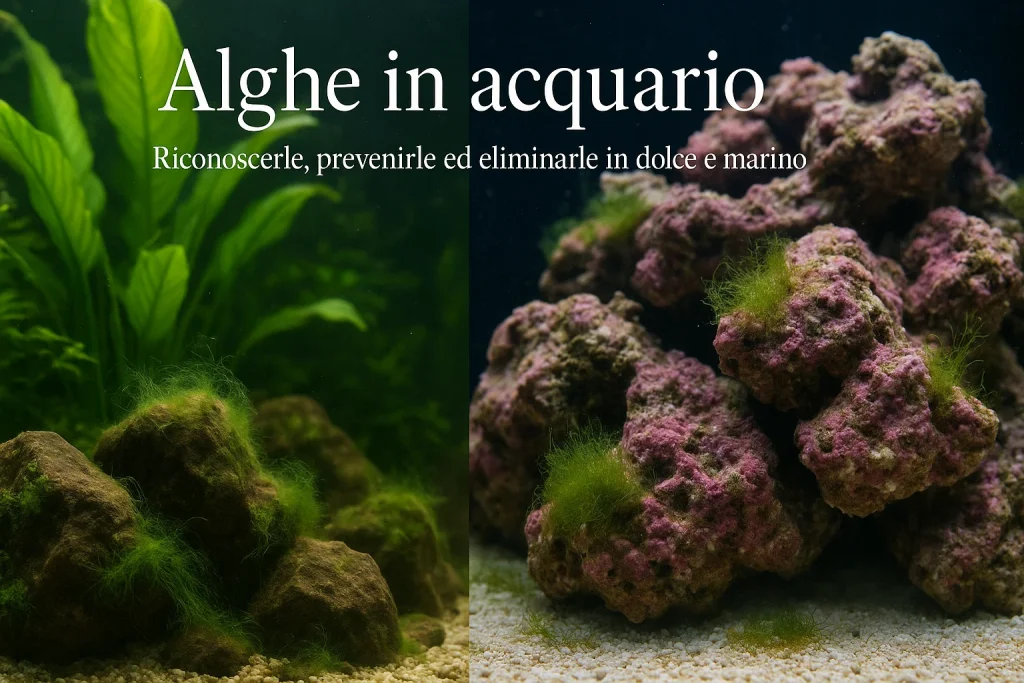
Algae in the aquarium, whether freshwater or marine, are one of those presences that every aquarist meets sooner or later. Many see them as a sworn enemy, and yet, from a biological point of view, they are a fundamental part of the ecosystem. They are not just “green dirt” on the glass, but complex organisms, with a structure of their own, a life cycle and a very precise ecological function.
🌱 In the wild they form the first stages of the food chain, they produce oxygen and they offer shelter to countless microorganisms. In the aquarium, their appearance can indicate that something is not balanced, but also that the tank is alive and in full biological activity.
Anyone who keeps a well-planted freshwater aquarium knows that a light veil of algae on wood and rocks can even make the tank look more natural. In a marine reef, on the other hand, seeing pink or purple corallines growing on the rocks is often a sign of biological maturity. The problem arises when the algae become invasive, cover useful surfaces and take resources away from plants or corals.
In this article we will address every aspect, distinguishing the most common species in freshwater and in marine water, with scientific and practical descriptions, real advice from the field and operational protocols. The aim is not just to “make them disappear”, but to understand why they appeared and how to maintain the balance so as to prevent them from coming back.
Algae in the freshwater aquarium: peculiarities of the environment
Freshwater aquariums are environments in which algae find very different conditions from those in marine ones. In freshwater, higher vegetation (fast-growing, floating and carpeting plants) competes directly with the algae for light and nutrients. This makes the management of algae often a question of plant balance.
💡 In a well-planted tank, healthy plants absorb nutrients so efficiently that they leave little room for algae. Conversely, in bare tanks or ones with slow plants, algae can easily take over.
Another important aspect is the type of management:
- Low-tech tanks (little light, no CO₂, minimal fertilisation): they tend to develop diatoms and slow green algae.
- High-tech tanks (powerful lights, pressurised CO₂, complete fertilisation): here instability in the nutrients or in the CO₂ can trigger explosions of filamentous, brush or spot algae.
The photoperiod plays a key role. In freshwater, keeping the light on for too long or with a spectrum skewed towards green-yellow can favour algae. Nutrients too must be balanced: nitrates too low compared with phosphates, or vice versa, break the balance and open the door to opportunistic species.
Finally, water movement in freshwater is not as intense as in marine water, and this can favour “stagnant” zones where algae accumulate, especially cyanobacteria and diatoms.
📦 Practical box – Basic prevention in freshwater
- Keep the plants healthy: fertilise in a balanced way (macro and micro elements).
- Avoid keeping the lights on for more than 8-9 hours a day.
- Keep the CO₂ stable in high-tech tanks.
- Clean the filters regularly and remove dead leaves.
- Introduce anti-algae fauna: Otocinclus, Ancistrus, Caridina japonica.
Classification and description of algae in the freshwater aquarium
Green algae (Chlorophyta)
Green filamentous algae (Oedogonium, Spirogyra, Rhizoclonium)
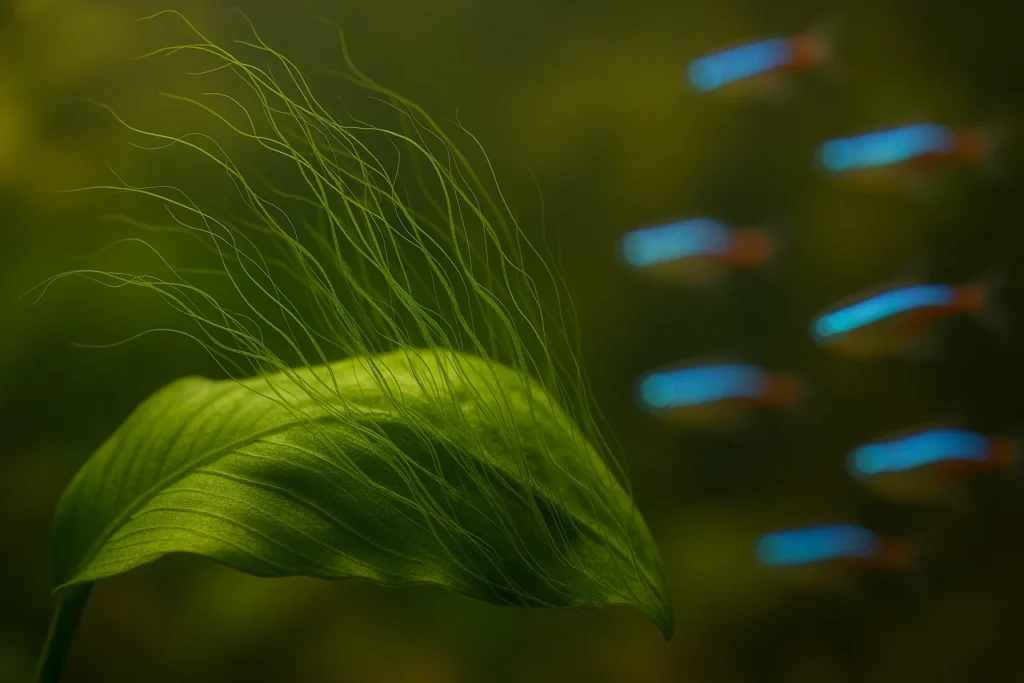
Green filamentous algae are among the most recognisable: long soft filaments, bright green in colour, which wind around plants, wood, decorations and sometimes form floating tangles.
📌 Recognition: if you try to pull them, they come away in elastic tufts. Under direct light they shine green.
📌 Causes: excess light combined with imbalances in the nutrients (often low nitrates and high phosphates, or unstable CO₂).
📌 Elimination:
- Natural: introduce specialised eaters (Crossocheilus siamensis, Caridina japonica).
- Manual: removal by hand or with small brushes, siphoning in the affected areas.
- Chemical: algicides based on glutaraldehyde or mild oxidisers, dosed carefully so as not to damage the plants.
📌 Prevention: keep NO₃ and PO₄ in a balanced ratio, avoid peaks of light without adequate CO₂.
Beard algae (Audouinella, also called BBA – Black Beard Algae)
Black or dark grey patches in the shape of a short “beard”, which attach themselves to slow leaves, wood and equipment.
📌 Recognition: resistant to removal, they often grow near the filter outlets where the current is stronger.
📌 Causes: unstable CO₂, shortage of macro elements, overfeeding.
📌 Elimination:
- Natural: Crossocheilus siamensis is the only fish known to eat them.
- Manual: prune the infested parts.
- Chemical: localised treatments with hydrogen peroxide or glutaraldehyde, switching off the filter for 15 min.
📌 Prevention: keep the CO₂ stable, clean the technical surfaces, limit excess food.
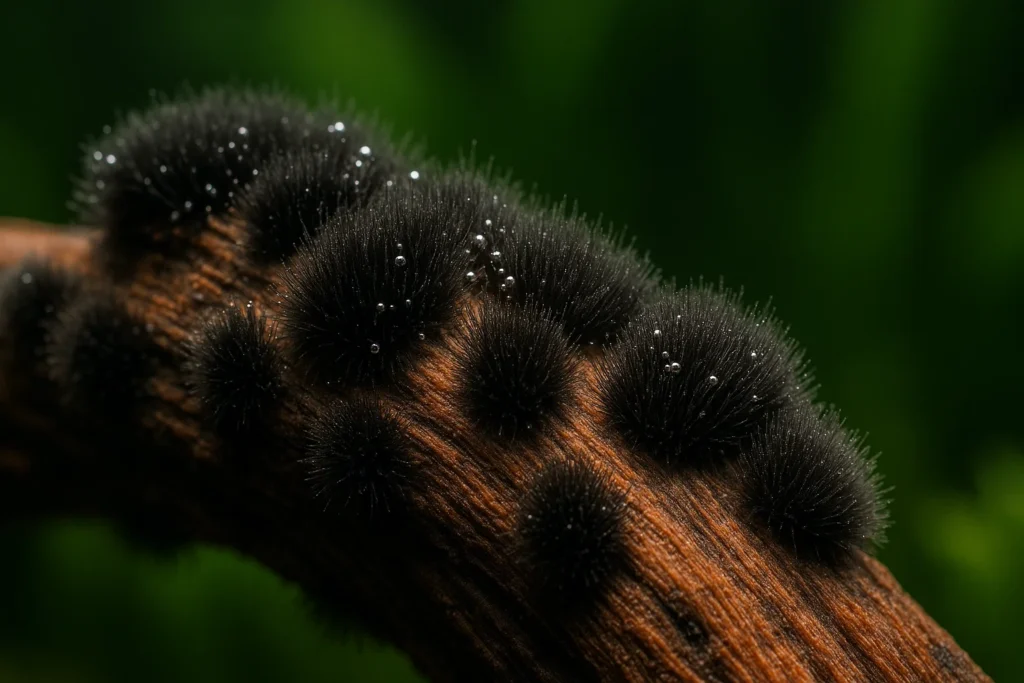
Brush algae (Compsopogon)
Similar to BBA but with longer, floating filaments. Colour from dark grey to olive green.
📌 Recognition: they look like small tufts of hair, especially on wood and rocks.
📌 Causes: nutrient imbalances, high phosphates, strong light.
📌 Elimination:
- Natural: few animals eat them, some Amano shrimp can help.
- Manual: cutting and removal.
- Chemical: spot treatments as for BBA.
📌 Prevention: the same approach as for BBA.
Green spot algae
Small hard green dots on the glass and sometimes on slow leaves such as Anubias.
📌 Recognition: difficult to scrape off, not soft like the filamentous ones.
📌 Causes: low phosphates, intense light, poor maintenance.
📌 Elimination:
- Manual: glass scraper, mechanical removal.
- Chemical: useless, they grow back if the system is not rebalanced.
📌 Prevention: keep PO₄ > 0.5 ppm in high-light tanks.
Cladophora (Cladophora aegagropila)
Green filamentous algae but stiffer and branched, often introduced with plants or decorations.
📌 Recognition: spongy consistency, resists tearing.
📌 Causes: often introduced accidentally, they thrive in intense light and nutrient-rich water.
📌 Elimination:
- Manual: careful removal piece by piece.
- Chemical: glutaraldehyde, but not always effective.
📌 Prevention: quarantine of plants and decorations.
Freshwater red algae (Rhodophyta)
In freshwater they are rare, but BBA belong to this group. They are resistant and often affect high-tech tanks with unstable CO₂.
📌 Recognition: colours from black to dark red, hard consistency.
📌 Causes: unstable CO₂, nutrient imbalances.
📌 Elimination: as for BBA.
📌 Prevention: stable CO₂ and fertilisation.
Brown algae (Phaeophyceae)
Very rare in freshwater, present only in particular conditions (brackish or cold fresh water). Generally not a common problem.
Diatoms (Bacillariophyceae) – Navicula, Synedra
A brown film that covers glass, decorations and leaves. Common in new tanks.
📌 Recognition: easily removed with the fingers, powdery consistency.
📌 Causes: high silicates, poor light, young tank.
📌 Elimination:
- Natural: Otocinclus, Ancistrus, Neritina snails.
- Manual: cleaning of glass and decorations.
📌 Prevention: reduce the silicates in the water, increase the light gradually.
Cyanobacteria – Oscillatoria, Anabaena
Foul-smelling, slimy green or blue-green mats. They are not true algae but photosynthetic bacteria.
📌 Recognition: strong smell, they come away in thin sheets.
📌 Causes: stagnant zones, accumulation of organic nutrients, shortage of nitrates.
📌 Elimination:
- Natural: improve the water movement, increase nitrates.
- Manual: complete siphoning of the affected areas.
- Chemical: treatments with specific antibiotics (careful with the filter bacteria).
📌 Prevention: uniform flow, regular cleaning, balanced nutrients.
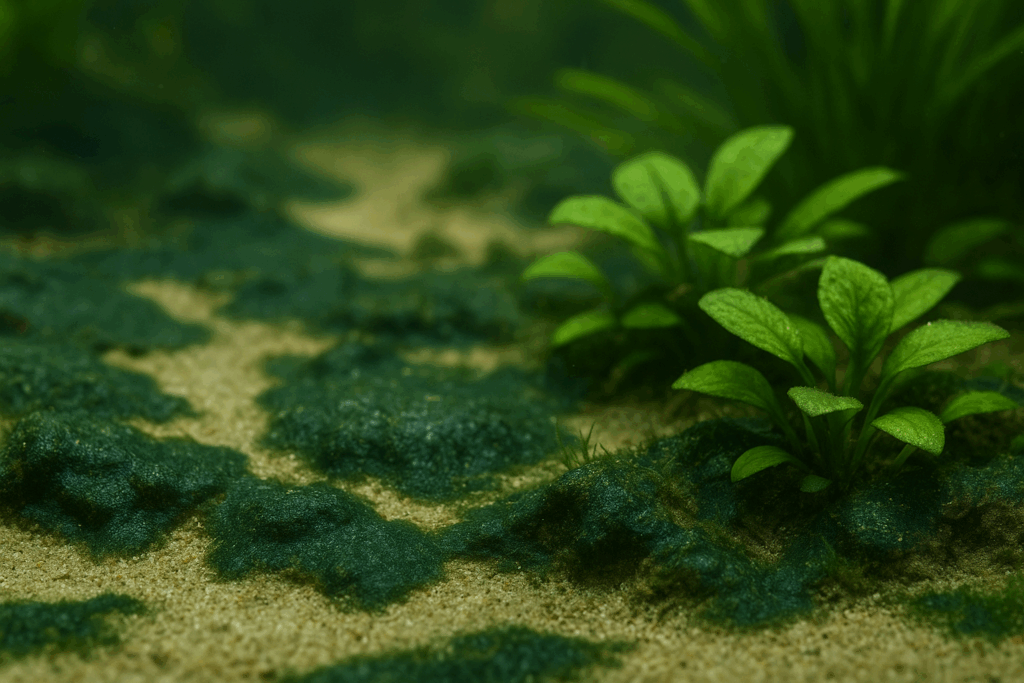
Euglenophytes – Euglena viridis
Water that turns cloudy green, especially in tanks exposed to direct sunlight.
📌 Recognition: green blooms in the water, impossible to see the bottom.
📌 Causes: exposure to the sun, high nutrients, unstable tank.
📌 Elimination:
- Natural: total blackout for 3-4 days, UV filter.
- Manual: water changes and fine filtration.
📌 Prevention: screen out the sunlight, keep the nutrients under control.
Floating algae – Hydrodictyon, Anabaena flos-aquae
They form nets or filaments at the surface, often in ponds or open tanks.
📌 Recognition: green structures with a visible mesh.
📌 Causes: still water, rich in nutrients.
📌 Elimination: manual collection, reduction of nutrients, introduction of competitive floating plants.
📌 Prevention: surface movement, limit excessive fertilisation.
📦 Practical box – operational approach in freshwater
- Identify exactly the type of alga by observation and, if necessary, microscopic analysis.
- Intervene immediately by reducing the primary cause (light, nutrients, CO₂).
- Add a natural control method with useful fauna.
- Apply, if indispensable, a targeted and temporary treatment.
- Keep the tank stable for at least 4 weeks after the intervention.
Algae in the marine aquarium: peculiarities and management
Marine aquariums have a different biological balance from freshwater ones. Here the competition between algae and corals is fierce, and in young or unstable tanks the algae can take advantage of the scarce presence of calcareous macroalgae and of a microbiome that is not yet mature.
🌊 In a mature reef, rocks covered with pink-purple corallines are the proof that conditions are stable and that unwanted algae are kept at bay. In young tanks, on the other hand, Bryopsis, Derbesia, dinoflagellates and cyanobacteria find fertile ground.
The photoperiod and the light spectrum play an even more important role than in freshwater, above all because many marine algae develop in response to specific wavelengths (blue, cyan, green). Water movement, often more intense, can limit the proliferation of some species but favour others that prefer strong currents.
The role of the skimmer and of nutrient control is also central: nitrates and phosphates must be neither too high nor at zero, on pain of the emergence of problematic species.
Green algae (Chlorophyta)
Bryopsis spp.
Perhaps the worst nightmare of the marine aquarist. Dark green, feathery filaments, which resist manual removal.
📌 Recognition: branched structure visible even to the naked eye, it grows by rooting deeply into the rock.
📌 Causes: nutrient imbalance, high iron, introduction from contaminated rocks or frags.
📌 Elimination:
- Natural: few animals touch it, sometimes Elysia spp. nudibranchs.
- Manual: difficult, it often grows back from microscopic fragments.
- Chemical: targeted treatments with fluconazole (careful with the impact on the microbiota).
📌 Prevention: quarantine of rocks and corals, balanced nutrients.
Derbesia spp.
Green filaments softer than Bryopsis, less rooted, with a “fine hair” appearance.
📌 Recognition: it grows quickly, it comes away more easily.
📌 Causes: high nitrates and phosphates, intense light.
📌 Elimination:
- Natural: Zebrasoma flavescens, Salarias fasciatus, Mespilia urchins.
- Manual: suction during water changes.
- Chemical: controlled oxidisers.
📌 Prevention: management of the photoperiod, stable nutrients.
Green film algae
A light green film on rocks and glass, common in the first stages of maturation.
📌 Recognition: easily scraped off, it grows back in a few days if the tank is young.
📌 Causes: intense light, absence of competitors, nutrient values not yet stabilised.
📌 Elimination: Turbo and Trochus snails; cleaning of the glass.
📌 Prevention: let the tank mature without excessive cleaning.
Caulerpa spp.
Fast-growing green macroalgae, some species decorative but invasive (Caulerpa racemosa, C. prolifera).
📌 Recognition: green stolons with various fronds (clustered, leaf-shaped).
📌 Causes: intense light and available nutrients.
📌 Elimination: regular pruning, watch out for “sporulation” in stressful conditions.
📌 Prevention: use in a refugium rather than in the display tank.
Red algae (Rhodophyta)
Calcareous corallines (Lithothamnion, Porolithon)
Beneficial, they indicate maturity and stability. They grow on rocks and glass in pink, purple, red.
📌 Recognition: crusts that are hard to the touch.
📌 Causes: good blue lighting, stable calcium and KH.
📌 Elimination: not necessary, on the contrary they are to be encouraged.
📌 Prevention: keep Ca, Mg, KH optimal.
Asparagopsis spp.
Filamentous red algae, often confused with others.
📌 Recognition: red-brown filaments that move in the current.
📌 Causes: high nutrients, lack of competitors.
📌 Elimination: manual removal, Mithrax sp., Zebrasoma spp.
📌 Prevention: balanced nutrients, herbivorous fauna.
Brown algae (Phaeophyceae)
Dictyota, Sargassum, Padina
Brown macroalgae, some with decorative fronds. Dictyota can be invasive.
📌 Recognition: flat fronds, light or dark brown in colour.
📌 Causes: nutrient imbalances, little herbivorous predation.
📌 Elimination: Diadema urchins, surgeonfish, manual collection.
📌 Prevention: balance nitrates/phosphates, introduce herbivores.
Diatoms (Bacillariophyceae)
Navicula, Amphora
A brown film on rocks and sand, typical of new tanks.
📌 Recognition: it lifts easily with a jet of water.
📌 Causes: high silicates, incomplete maturation.
📌 Elimination: Nassarius, Trochus, Turbo snails.
📌 Prevention: anti-silicate filtration, patience during maturation.
Cyanobacteria
Lyngbya, Oscillatoria marina
Red, green or brown mats, slimy and foul-smelling.
📌 Recognition: a gelatinous film that traps oxygen bubbles.
📌 Causes: NO₃/PO₄ imbalance, inadequate flow, accumulation of detritus.
📌 Elimination: mechanical suction, increased movement, targeted doses of marine antibacterials.
📌 Prevention: maintain the Redfield ratio, avoid dead zones.
Dinoflagellates
Ostreopsis, Prorocentrum, Amphidinium
Unicellular microalgae that are toxic in certain conditions. They form golden brown mats and release toxins that are dangerous for corals and fish.
📌 Recognition: a brown film with tiny bubbles, it re-forms within a few hours after removal.
📌 Causes: nutrients too low, reduced bacterial competition.
📌 Elimination: partial blackout, increase of nutrients to physiological values, UV steriliser, competing bacteria.
📌 Prevention: avoid extreme ULNS, maintain bacterial biodiversity.
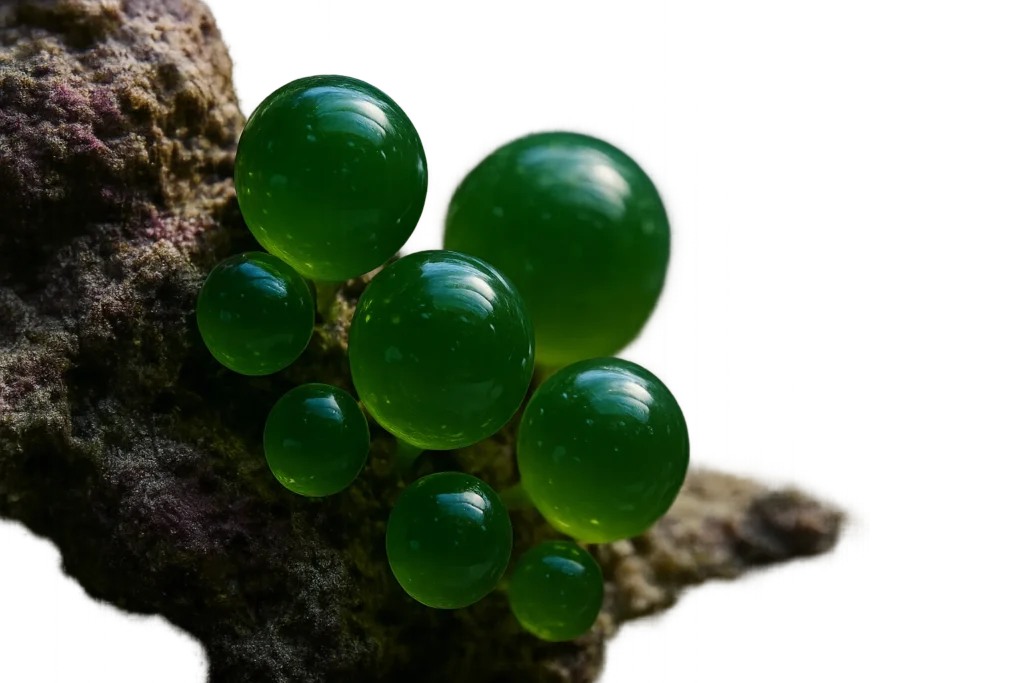
Bubble algae (Valonia ventricosa, Ventricaria spp.)
Shiny, hard green spheres, which can detach and spread.
📌 Recognition: single bubbles or clusters.
📌 Causes: arrival on live rock or contaminated frags, available nutrients.
📌 Elimination: Mithrax crabs, manual removal without breaking them (to avoid the release of spores).
📌 Prevention: inspect frags and rocks before introduction.
📦 Practical box – operational approach in marine water
- Identify the alga precisely, avoiding random treatments.
- Intervene before it becomes dominant.
- Always use a combination of methods: natural + manual + chemical if necessary.
- Keep NO₃ and PO₄ in the physiological range (NO₃ 2-10 ppm, PO₄ 0.03-0.08 ppm).
- Do not over-sterilise the system: biodiversity is an ally.
Operational anti-algae protocols
📦 Emergency protocol for an algal invasion
- Rapid identification
Take photos, compare with reliable profiles or analyse under the microscope. Avoid “blind” interventions. - Checking the parameters
Measure NO₃, PO₄, pH, KH, silicon, iron. Note down the values to understand whether the cause is nutritional. - Immediate physical removal
Suck up, scrape or prune the infested zones, even if you know they will grow back: reduce the initial biomass. - Targeted action
- Freshwater: anti-algae fauna, increased CO₂, macro/micro balancing.
- Marine: herbivores, increased biodiversity, targeted filtration.
- Long-term stabilisation
Keep the parameters optimal and the light regulated, avoid swings.
📦 Weekly prevention checklist
- Check the duration and the spectrum of the lighting.
- Observe the least lit zones or those with little movement: the first colonies often start there.
- Remove the small colonies by hand before they spread.
- Keep the anti-algae fauna healthy and well fed.
- Clean the pumps and the filter to maintain optimal flow.
FAQ
How do I tell an alga from a cyanobacterium?
True algae have a plant structure and chloroplasts, cyanobacteria are mucilaginous, they smell of earth or mould and they come away in films. In marine water, cyano often trap tiny bubbles.
Can I eliminate all the algae in the tank?
No, and you should not. A light veil of algae is natural and healthy. The aim is control, not total eradication.
Are algicides safe?
If used correctly and only when necessary, yes. But by killing algae en masse, they can release nutrients and toxins: act gradually.
How much light is needed to avoid algae?
There is no magic number. In freshwater, balance the hours and the intensity with the needs of the plants. In marine water, calibrate the spectrum for the corals as well, avoiding an excess of green-yellow.
Is it better to intervene with fauna or with chemical products?
Fauna is always the first choice. Chemical products are a weapon to be used with judgement and only if the natural methods fail.
Glossary
Chlorophytes – Green algae, a common group in freshwater and marine water.
Rhodophyta – Red algae, they include calcareous corallines and filamentous species.
Phaeophyceae – Brown algae, more common in marine water.
Diatoms – Microscopic algae with a silica shell, often a brown film.
Cyanobacteria – Photosynthetic bacteria, similar to algae but bacterial in nature.
Dinoflagellates – Unicellular microalgae, some of them toxic.
CO₂ – Carbon dioxide, essential for the growth of aquatic plants.
Photoperiod – Daily duration of the lighting.
Redfield ratio – The ideal theoretical ratio between nitrogen and phosphorus (16:1 in atoms).
Fluconazole – An antifungal used off-label to treat Bryopsis in marine water.
Skimmer – A mechanical filtration device for marine aquariums that removes proteins and organic compounds.
Share questo articolo:
Text reviewed by a human editor before publication. Editor responsible: Francesco Avezzano, a journalist registered with the Order of Journalists of Campania. How I use artificial intelligence