Cyanobacteria in the Aquarium: Causes, Prevention and Solutions
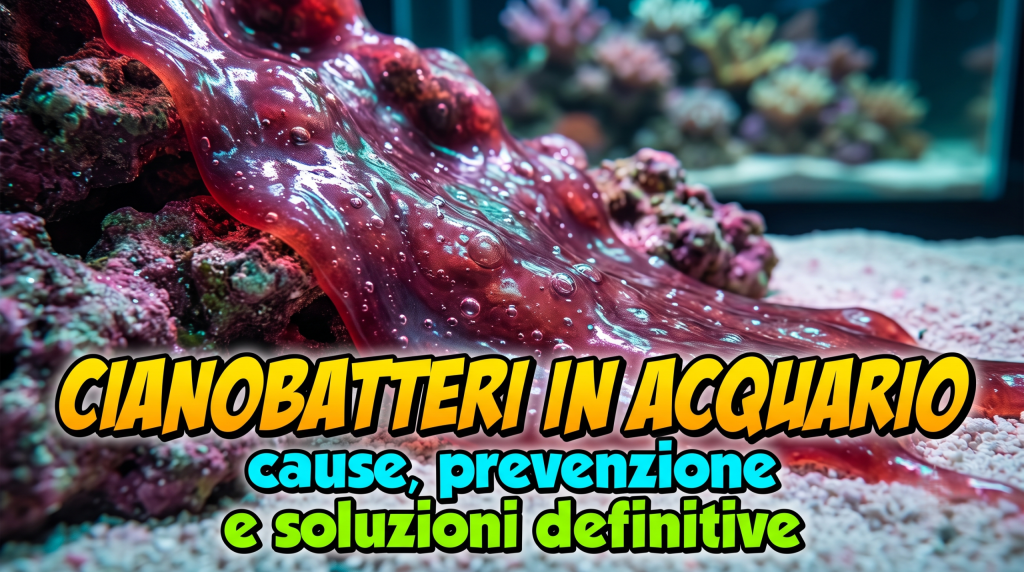
Cyanobacteria are not algae and they are not a chemical problem to be plugged with a bottle. They are extremely ancient bacteria that colonise fresh and marine water when the tank offers them an advantage that no other organism knows how to exploit. Understanding that advantage, even before fighting them, is the only way not to find them all over the tank again every two months. This is a technical manual, without shortcuts and without inflated promises.
What cyanobacteria are
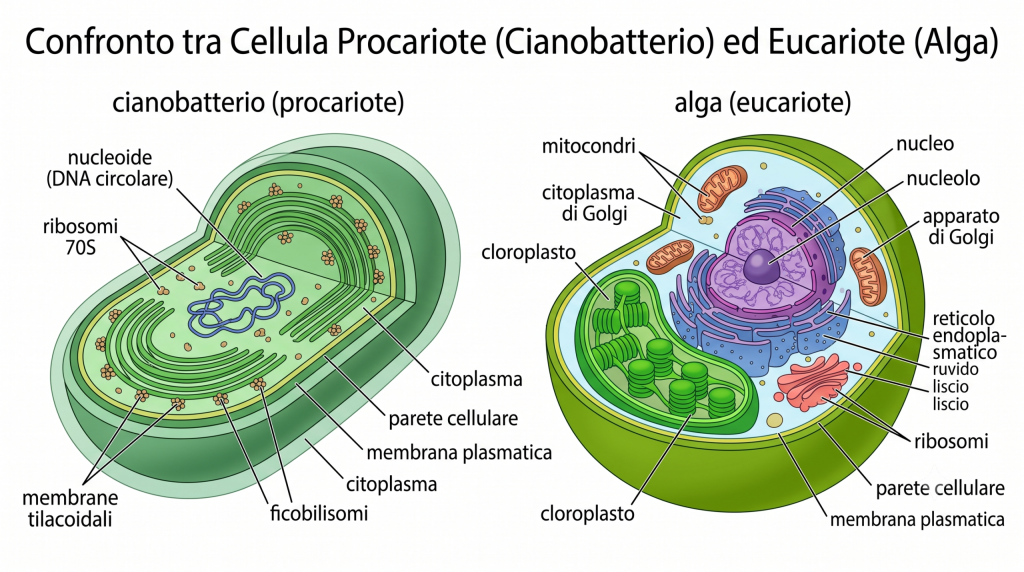
Let us start with the mistake that ruins half of all control strategies. Cyanobacteria are not algae. They are bacteria, prokaryotic organisms, that is cells lacking a nucleus and internal organelles. Algae, including the red ones the film resembles, are instead eukaryotes, with a completely different cellular structure. Calling them “red alga” or by the old name “blue-green algae” (Cyanophyta) is convenient but taxonomically false, and that confusion leads to applying remedies designed for algae which on bacteria simply do not work.
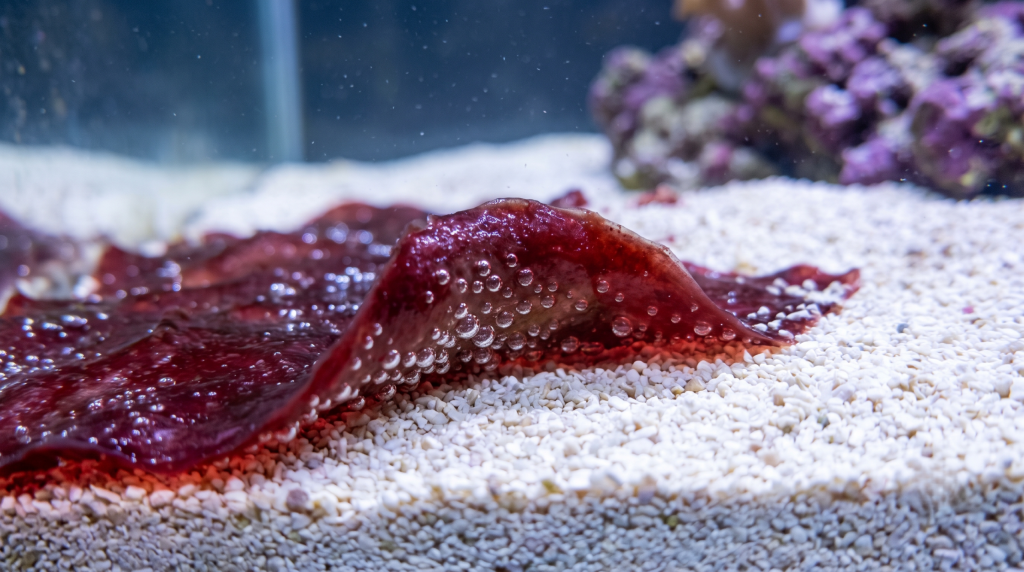
What makes them special is a biological first. Cyanobacteria are the only prokaryotes capable of oxygenic photosynthesis, the same reaction carried out by plants and algae, with production of oxygen from light, water and carbon dioxide. They contain chlorophyll a, but also a battery of accessory pigments called phycobiliproteins: phycocyanin, blue in colour, and phycoerythrin, red in colour. The ratio between these pigments changes according to the available light, a phenomenon called chromatic acclimation. It is the reason why the same strain can appear bright red on an illuminated rock, dark green in a shaded area, brown or purple elsewhere. Colour alone does not identify the species.
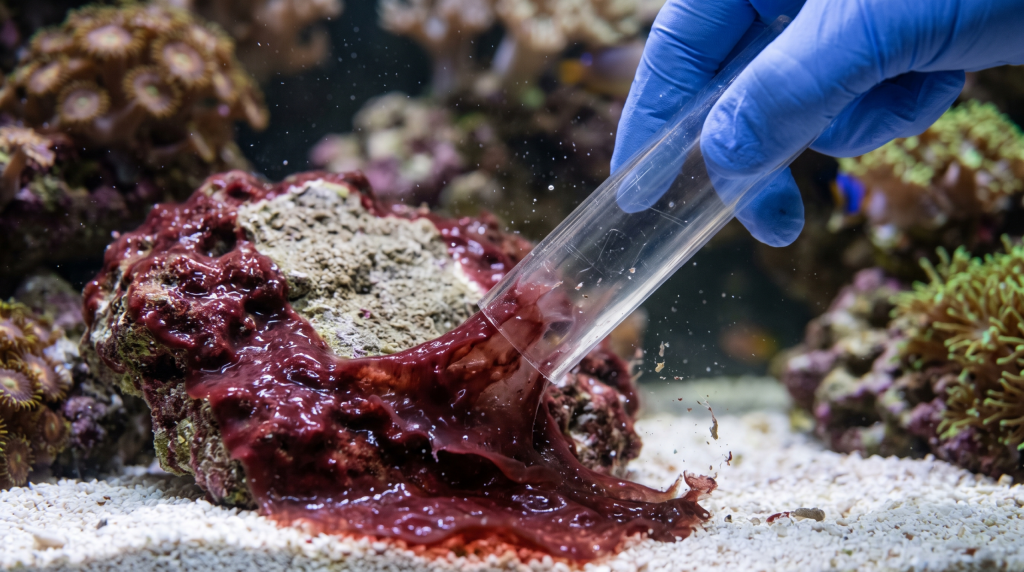
In the tank they organise themselves into biofilms, gelatinous mats that cover every surface: sand, rocks, glass, pipes, leaves. The mucilaginous consistency and the unpleasant smell, a mixture of wet earth, mud and sometimes acetone, are among the most reliable signs for recognising them.
A history as long as life on Earth
It is not a museum detail. Cyanobacteria are among the most ancient life forms on the planet, with fossil evidence exceeding 3 billion years. It was they who, slowly filling the atmosphere with oxygen, triggered around 2.4 billion years ago the so-called Great Oxidation, the event that made complex life possible. I call them, not by chance, the planet’s first oxygenators.
Understanding this antiquity serves one practical purpose: respecting the adversary. An organism that has crossed geological eras, mass extinctions and extreme ocean chemistries does not surrender to a week of darkness or a bottle of antibiotic. It is metabolically flexible, it knows how to enter dormancy and it knows how to start again from the first surviving shred. When an aquarist says “I had eliminated them and they came back”, almost always he had not eliminated them at all: he had reduced the visible biomass while leaving intact the conditions that favour them.
How you recognise them in the tank
The typical picture is unmistakable. First a thin veil appears, often on a poorly illuminated rock or in a low-flow corner, almost transparent. Within days it becomes a compact mat that detaches in whole sheets, like a film, and drags air bubbles along with it. Those trapped bubbles are photosynthetic oxygen produced by the biofilm itself, an almost diagnostic clue. True filamentous algae do not behave like this.
The colours, as said, vary from brick red to bottle green, from brown to purple. The surface is slimy, slippery under the fingers, not fibrous. And then there is the smell, which does not go unnoticed when you open the lid.
Take care not to confuse them with other organisms. Diatoms, the classic brown film of young tanks, are powdery and dissolve at the slightest movement of the water; they do not form cohesive sheets. Mat algae are fibrous and firmly anchored. The practical difference is enormous, because every pest organism responds to different management and getting the identification wrong means wasting weeks.
Why they appear, the biochemistry of imbalance
Here lies the scientific heart of the article. Cyanobacteria do not arrive because the tank is “dirty” in a generic sense. They arrive because a precise combination of conditions is created that suits them and does not suit the other organisms.
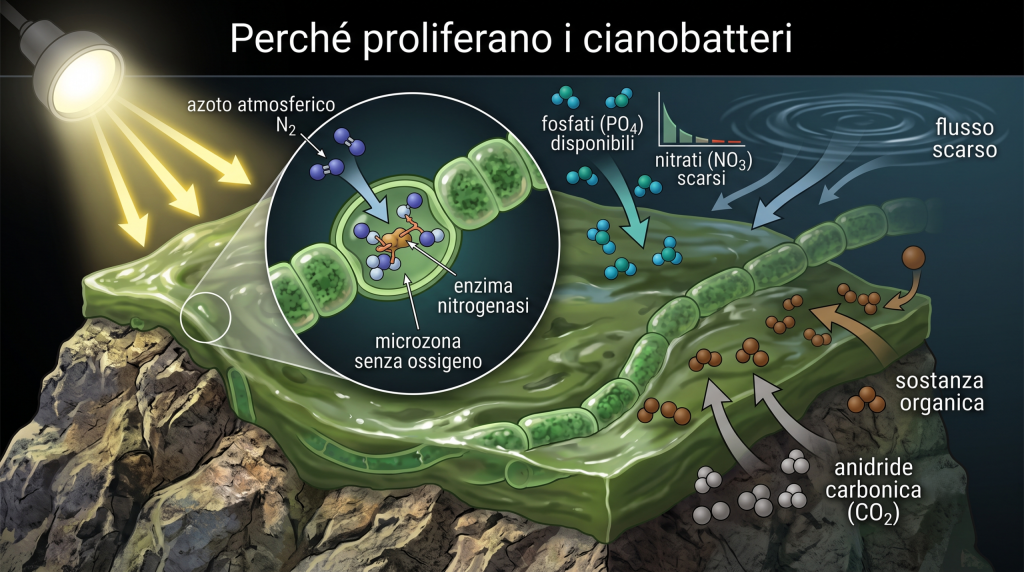
The first factor, the most misunderstood, is nitrogen. Many cyanobacteria possess an enzyme called nitrogenase, which allows them to fix the atmospheric nitrogen dissolved in the water, transforming molecular nitrogen into usable ammonia. In practice they produce the fertiliser themselves. This capacity, called diazotrophy, is a devastating competitive advantage in tanks with low or zeroed nitrate. While algae, plants and competing bacteria suffer the nitrogen shortage, cyanobacteria do not care and prosper. There is an elegant detail: nitrogenase is destroyed by oxygen, and cyanobacteria produce oxygen continuously through photosynthesis. How do they resolve the paradox? Inside their thick and mucilaginous mats, micro-zones free of oxygen form, in which the enzyme can work protected. The biofilm is not only aesthetics, it is a biochemical reactor. It must be said honestly that not all cyanobacteria fix nitrogen and that quantifying this contribution in a single home tank is impossible without laboratory analysis, but as a general mechanism it perfectly explains why the tanks obsessed with zero nutrients are the most affected.
The second factor is phosphorus. When phosphates (PO4) are abundant while nitrates (NO3) are scarce, the ideal imbalance is created. In oceanography the Redfield ratio is cited, roughly 16 parts of nitrogen to 1 of phosphorus in marine plankton. It is not a value to be pursued rigidly in an aquarium, and whoever treats it as dogma is mistaken, but the underlying concept remains valid: when nitrogen becomes the limiting factor and phosphate remains available, cyanobacteria cash in their diazotrophic advantage and take off.
The third factor is dissolved organic matter, often indicated as DOC (Dissolved Organic Carbon), that is the mass of carbon compounds deriving from uneaten food, excrement, decomposing leaves and accumulated detritus. It is fuel. A substrate loaded with detritus beneath the surface is the perfect cradle, because it combines slow-release nutrients, anoxic zones and absence of movement.
The fourth factor is hydraulic. Cyanobacteria hate movement and abundant oxygen, and love dead zones: the corners of the sump, the back of the rocks, the edges of the substrate where the flow does not reach. In those stagnant pockets they settle undisturbed.
The fifth factor is light. Too long a photoperiod helps them, but above all the spectrum counts. An aged lamp loses intensity and shifts its own peak towards red, and that spectral shift favours cyanobacteria over the organisms we would like to grow. It is one of the most underestimated causes of all, because to the naked eye the lamp seems to be working perfectly well.
Cyanobacteria in the freshwater aquarium
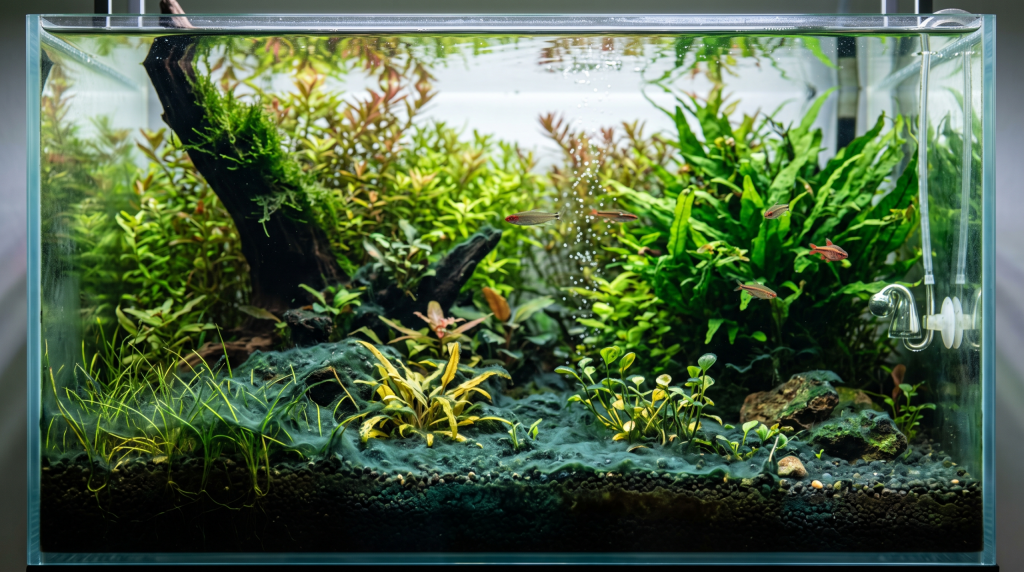
In the freshwater aquarium, in particular in the planted one, cyanobacteria are often the genera Oscillatoria and Phormidium. The classic picture is the veil that creeps along the substrate and smothers the plants in the front row, those already suffering.
The typical causes add up to one another. Nitrates too low, as usual, combined with a substrate loaded with detritus because siphoning has been reduced, perhaps after adding a fine substrate to favour carpeting plants. I add to this the most common trap of all: the old lamp with the spectrum shifted to red, which nobody suspects because it still illuminates. A photoperiod stretched long to stimulate the plants ends up rewarding the bacteria.
The most powerful lever, and the most counter-intuitive, is raising the nitrates when they are deficient. In a planted tank this means dosing nitrogen and, almost always, potassium, because well-nourished plants in vigorous growth take ground away from cyanobacteria by depriving them of phosphorus and space. Rebalancing the ratio between nitrogen and phosphorus, instead of zeroing everything, gives the advantage back to the higher plants. In parallel more movement is needed, less excess food and regular siphoning of the substrate to dispose of the detritus.
A note on oxygen and CO2. Adding an aerator helps immediately, because it mechanically disturbs the mats and oxygenates the dead zones in which the bacteria prosper. But it is a temporary measure, because the aerator degasses the CO2 that the plants need in order to grow. It is used in an emergency, then removed when the ecosystem has regained control. Whoever leaves it switched on for ever solves the cyanobacteria and sinks the plants, that is he exchanges one problem for another.
Cyanobacteria in the marine aquarium
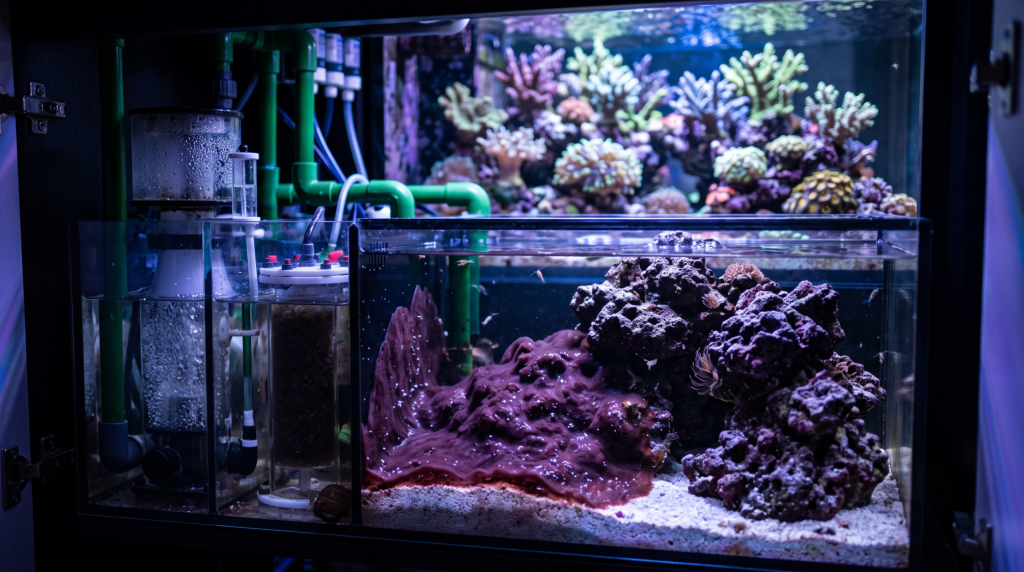
In the reef the problem presents itself with the classic red or purple film that those who keep corals know well, often attributed to phycoerythrin. It is perhaps the most frustrating form, because it coexists with delicate animals that limit the room for manoeuvre.
The causes have some marine specificities. Outbreaks on dry rock, so-called dry rock, are a classic: the sterile rock releases phosphates and compounds for weeks while the competing microbiome has not yet settled in, and cyanobacteria fill the ecological vacuum. New tank syndrome falls within the same logic. Then there is the imbalance between nitrates and phosphates, typically low nitrates and phosphates in excess, aggravated by the obsession with zero nutrients that pervades a certain part of the marine hobby. The dead zones of the sump and the back of the rocks complete the picture. The aged lamp applies here too.
There is a wrong turn that I see repeated. Many reefkeepers push nutrient export to the maximum, with an exaggerated skimmer, resins, zeolites and biopellets, convinced that a “cleaner” tank is a healthier tank. It is not. A tank with zero nitrates is not healthier, it is more vulnerable, because it deprives the beneficial microbial community of the nitrogen necessary to compete. It is in that nutritional desert that cyanobacteria, and not only they, find the field free.
The marine countermeasures follow the general ones, with a few precautions. Manual removal with a siphon remains the first intervention. Then nutritional rebalancing, which in a reef may include controlled dosing of nitrate to break the nitrogen deficiency, a delicate operation to be carried out gradually and while monitoring the corals. The flow must be reviewed to cancel the dead zones, adding pumps where needed. A refugium with macroalgae such as Chaetomorpha helps to stabilise the nutrients and to take ground away from the bacteria. Dosing beneficial bacterial consortia serves to repopulate the microbial competition. And checking the source water is fundamental: a reverse osmosis unit, the union of reverse osmosis and deionisation that we call RO/DI, must produce water practically free of dissolved salts, with TDS values, that is the total concentration of dissolved solids measured in parts per million, close to zero. An exhausted membrane that lets phosphates and silicates through feeds the problem at the source.
The toxins of cyanobacteria and the real risks
Let us talk about it without alarmism and without minimising, because on this point both excesses circulate. Several cyanobacteria produce cyanotoxins, among them microcystin, hepatotoxic, anatoxin, neurotoxic, saxitoxin, also neurotoxic, and the skin toxins of genera such as Lyngbya, together with the endotoxins of the bacterial wall. They are real and documented compounds.
Now the honest calibration. Serious acute cases in people almost always derive from large environmental blooms in lakes and seas, not from a home tank. But the toxins remain, and a dense infestation can stress fish, shrimp and corals, both through direct contact and smothering of the surfaces, and through the night-time anoxia that a photosynthetic mat causes when at night it consumes oxygen instead of producing it. On the aquarist’s side, handling large quantities of mat with bare hands or starting siphons with the mouth are bad ideas. And since it is not possible to know which toxin, if any, the specific strain in one’s own tank produces without a laboratory analysis, the reasonable prudence is to treat every dense infestation with a minimum of respect.
How to eliminate them by acting on the cause
We come to the method, and it is here that I separate the real solution from the palliatives. The golden rule is only one: act on the cause, not only on the symptom. Any approach that kills the biomass without removing the starting conditions leads to a reappearance, often more aggressive.
The first step is always manual removal. Siphoning away the visible mats every day, gently, reduces the biomass and the share of toxins in circulation. It is tedious, hardly heroic, but essential. The fewer there are, the fewer you have to fight. In parallel the fuel is cut off: less food, siphoning of the detritus on the substrate, filter maintenance to empty the reservoirs of organic matter.
The second step is the rebalancing of nutrients, the real switch. In tanks with low nitrates, raising them in a controlled way removes from cyanobacteria their diazotrophic advantage and feeds the competition. In freshwater it means dosing nitrogen and potassium in favour of the plants. In marine it means managing nitrates and phosphates towards measurable and stable values, without pursuing zero. I repeat the concept because it is the most disregarded: a tank with zeroed nutrients is not clean, it is starved, and starvation favours the bacteria.
The third step is hydraulic and respiratory. Increasing the flow in the dead zones and improving oxygenation makes the environment hostile to cyanobacteria, which prefer stagnation and micro-anoxia. Repositioning a pump is often worth more than a bottle.
The fourth step is biological. Restoring and strengthening the competition: fast-growing plants in freshwater, refugium macroalgae in marine, a mature and stable microbiome, the possible dosing of beneficial bacteria. Cyanobacteria are opportunistic scavengers that advance where the competition has been weakened. Giving it back against them is the strategic move.
The direct methods and their hidden costs
There remain the shock approaches, those that act on the effect. They work more or less well, but they all have a common defect: if you do not touch the cause, the problem returns. I explain them with their real risks, because nobody tells you about them before selling them to you.
The blackout, that is total therapeutic darkness, exploits the fact that cyanobacteria are photosynthetic. The tank is covered completely for a period that usually goes from 3 to 5 days, with strong flow and aeration and a final water change. In freshwater robust plants take the blow and recover. In marine with corals the matter changes a great deal, because photosynthetic animals too suffer prolonged darkness and the oxygen can collapse at night, so it must be evaluated with extreme caution and it is not a neutral option. In no case should it be repeated at very short intervals, because a stress of that kind, replicated, destabilises the entire ecosystem.
Hydrogen peroxide, common oxygenated water, acts by oxidation, degrading the bacterial cells. In freshwater it is used in targeted application on the mats with the pumps switched off, or at very low concentration in the tank. The protocols circulating among aquarists speak of hydrogen peroxide at 3 per cent in reduced doses with brief exposure and an immediate water change, but they are empirical data from field experience, not standards validated by the scientific literature, and the results vary quite a lot. In a marine tank with corals it is generally inadvisable and risky, and if somebody decides to try it anyway it must be done only in targeted micro-doses, accepting the risk. There is no independent and certified reef dosage that I can declare safe, and whoever promises one is lying.
Antibiotics are the strongest temptation and the most insidious trap. Erythromycin is an antibiotic of the macrolide family that binds to the 50S subunit of the bacterial ribosome and blocks protein synthesis. On cyanobacteria, which are bacteria, it works, and it makes them disappear quickly. The problem is that it does not distinguish: it also strikes the nitrifying and denitrifying flora of the substrate, of the rocks and of the filter. The result can be a toxic nitrite peak, an induced mini cycle, and the selection of resistant strains, cyanobacteria included. Historically chloramphenicol was also used, extremely effective and rightly fallen into disuse, both for the same side effects and because it is a strongly regulated antibiotic for human use. The commercial products of the sector, the various red film removers, have a composition not officially declared but are widely believed to be based on erythromycin or similar macrolides. They require heavy aeration during use, because the bacterial die-off consumes oxygen, and a water change with carbon at the end. They must be considered the last resort, never the first move, and always with the awareness that they treat the symptom.
Finally the UV lamp, which many buy hoping for a miracle. UV sterilises the microorganisms that pass through the chamber, so it works on the organisms that swim freely in the water. Cyanobacteria are benthic and anchored to the surfaces, they do not circulate in the UV, and for this reason on an already established mat the UV does almost nothing. It is money badly spent if one expects it to solve a cyanobacteria infestation.
Long-term prevention
The truth is that cyanobacteria are beaten before they appear. A well-designed tank simply makes them non-competitive.
A mature and stable microbiome is needed, not zeroed by excesses of sterilisation. Discipline in feeding is needed, because excess food is the first source of dissolved organic matter. Regular maintenance is needed, with siphoning of the substrate and cleaning of the filter so as not to leave accumulations of detritus. The lamps need replacing according to a sensible schedule, because over time they lose intensity and shift the spectrum to red to the advantage of the bacteria, long before they seem “spent”. A design of the flow is needed that eliminates the dead zones, behind the rocks, in the corners of the sump, at the edges of the substrate. Source water of quality is needed, produced with RO/DI and checked in TDS, with an efficient membrane. And above all it is necessary to abandon the obsession with zero nutrients: maintaining low but measurable and stable values of nitrates and phosphates is healthier and safer than pursuing the chemical desert that invites cyanobacteria and not only them.
For those who are beginners and for those who are not
If you are at the beginning, the road is the boring and winning one: patient manual removal, correction of the flow, discipline over food and nutrients, time. Stay away from antibiotics, which in inexperienced hands do more damage than the cyanobacteria.
If you have intermediate experience, you can actively manage the nutritional rebalancing and consider a blackout in freshwater. If you are an advanced aquarist, above all in the reef, you can dose the nutrients with precision, use targeted interventions and work on the microbial competition with bacterial consortia.
On expectations be realistic. Systemic correction shows the first results in two to four weeks and reaches full stability in a few more weeks. The chemical blow cleans up in a few days, but without correcting the cause the relapse is almost guaranteed. It is not pessimism, it is the way biology works.
Conclusion
After years spent watching tanks fill up with and free themselves of cyanobacteria, my conviction is clear-cut: they are not an enemy to be brought down, they are a messenger to be listened to. When they appear, they are telling you something precise about your system, an imbalance between nitrogen and phosphorus, a stagnation, an organic load, a tired lamp. Whoever runs to the bottle silences the messenger and ignores the message, and indeed finds them all over the tank again season after season.
On the title of this article I must be honest all the way, because you asked me for truth and not marketing. The expression “definitive solutions” is in part an inflated promise. There is no pill that eliminates cyanobacteria for ever, because they are not an isolated chemical problem but the symptom of a condition. The definitive solution, the real one, is not a product: it is a tank managed in such a way that it is no longer worth existing there for cyanobacteria. That one you build yourself, with balance and patience, and no bottle will ever sell it to you.
Frequently asked questions
Are cyanobacteria algae?
No, and this is not pedantry. They are bacteria, prokaryotic organisms, while algae are eukaryotes. The difference counts because many remedies designed for algae do not work on bacteria, and vice versa.
Why have they appeared if my tank has very low nutrients?
Because very low nutrients are often the cause, not the protection. Many cyanobacteria fix atmospheric nitrogen and prosper precisely where nitrates are zeroed and phosphates remain available. The nitrogen deficiency starves the competition and hands them the field.
Is it true that raising nitrates helps against cyanobacteria?
Yes, when the nitrates are deficient. Raising them in a controlled way removes from cyanobacteria the diazotrophic advantage and feeds the competing organisms. It is not a universal cure, it is the correction of a specific imbalance, and it must be done in measure.
Does the blackout work in a marine aquarium with corals?
It works on cyanobacteria because they are photosynthetic, but in the reef it is risky, because corals too suffer prolonged darkness and the oxygen can collapse at night. It must be evaluated with extreme caution and it is not a neutral move as it is in the planted freshwater tank.
Is hydrogen peroxide safe in the tank?
In freshwater, in targeted application and at low concentration, it is used with variable results, but it remains an empirical datum, not a validated standard. In marine with corals it is inadvisable and risky. In excess it damages fish, shrimp, plants, corals and bacterial flora.
Do ChemiClean and similar products contain antibiotics?
The composition is not officially declared, but these red film removers are widely believed to be based on erythromycin or related macrolides. That is why they have the same risks as an antibiotic and must be treated as such.
Does erythromycin destroy the biological filter?
It can do. It is a macrolide that blocks bacterial protein synthesis without distinguishing between cyanobacteria and nitrifying flora. The concrete risk is a nitrite peak, an induced mini cycle and the selection of resistant strains.
Does the UV lamp eliminate cyanobacteria?
Almost not at all, on an already established mat. UV strikes what passes into its chamber, that is the organisms free in the water. Cyanobacteria are anchored to the surfaces and do not circulate, so the UV does not reach them.
Are cyanobacteria toxic to fish and corals?
They can be. Various strains produce cyanotoxins, and a dense mat stresses the animals through contact, smothering of the surfaces and night-time anoxia. Not all strains are equally toxic, but a thick infestation is harmful all the same.
Are they dangerous for me who puts my hands in there?
Serious cases in humans concern large environmental blooms, not the tank at home. That said, handling large quantities of mat with bare hands or starting siphons with the mouth are practices to be avoided, because the toxins and the endotoxins are there.
Why do they always come back after the treatment?
Because the treatment reduced the biomass without removing the cause. As long as the nutritional imbalance, the stagnation or the organic load that favoured them remain, the first surviving shred starts again. You had not eliminated them, you had only pruned them.
How much time is needed to eliminate them stably?
Systemic correction shows the first signs in two to four weeks and stabilises in a few more weeks. The chemical blow cleans up in a few days but almost always relapses. The slow way is the only one that lasts.
Is my skimmer not enough to prevent them?
No, and sometimes it is part of the problem. An exaggerated skimmer, pushed together with resins and biopellets in the hunt for zero nutrients, creates precisely the nutritional desert in which cyanobacteria win. The instrument is useful, the obsession with export is not.
Do cyanobacteria grow more in new tanks?
Yes, a great deal. In young tanks the competing microbiome has not yet settled in, the materials release compounds and the ecological niches are free. It is the most fertile moment for a bacterial colonisation.
Does dry rock favour cyanobacteria?
Often yes, in the initial phase. Dry rock is sterile and releases phosphates and compounds for weeks while the beneficial community is not yet there. That ecological vacuum is an invitation, and cyanobacteria accept it.
Do zeolites or biopellets help or make things worse?
It depends on the use. Pushed to the extreme to zero the nutrients, they can contribute to the imbalance that favours cyanobacteria. Used to maintain low but stable values, without pursuing zero, they are legitimate instruments.
Should I increase the flow everywhere or only in the dead zones?
Concentrate on the dead zones, that is the stagnant corners where cyanobacteria settle. A well-distributed flow that eliminates the pockets of stagnation is worth more than generic power fired at random.
Are red cyanobacteria and green ones different?
Not necessarily as species. The colour depends on the ratio between the pigments, the blue phycocyanin and the red phycoerythrin, which varies with the available light. The same strain can appear in different colours, so colour is not a reliable identification criterion.
Can I use fish or invertebrates that eat them?
Very unreliable. Most animals avoid cyanobacteria, which can be toxic and unpleasant. Some pick at them, but no cleaner solves an infestation, and relying on this distracts from the correction of the cause.
Do activated carbon or anti-phosphate resins solve it?
They are support instruments, not solutions. Reducing excess phosphates can remove fuel, but if the problem is the nitrogen deficiency, lowering the nutrients further makes it worse. They must be used with judgement, within a strategy, not as an isolated remedy.
Does the old light really have something to do with it?
Yes, and it is one of the most underestimated causes. Over time the lamp loses intensity and shifts the peak towards red, favouring cyanobacteria, long before it seems exhausted to the eye. Replacing it in good time is pure prevention.
Better frequent water changes or few and targeted ones?
Better targeted and constant, within a strategy. Regular water changes help to export organic matter and to stabilise the parameters, but on their own they do not switch off an infestation if the underlying imbalance remains.
Does the Balling method or nutrient dosing favour them?
Not in itself. Balling manages calcium, magnesium and carbonates, not the nutrients that feed cyanobacteria. If anything it is the unbalanced management of nitrates and phosphates, or the hunt for zero, that makes the difference.
How do I distinguish cyanobacteria from a powdery or filamentous mat?
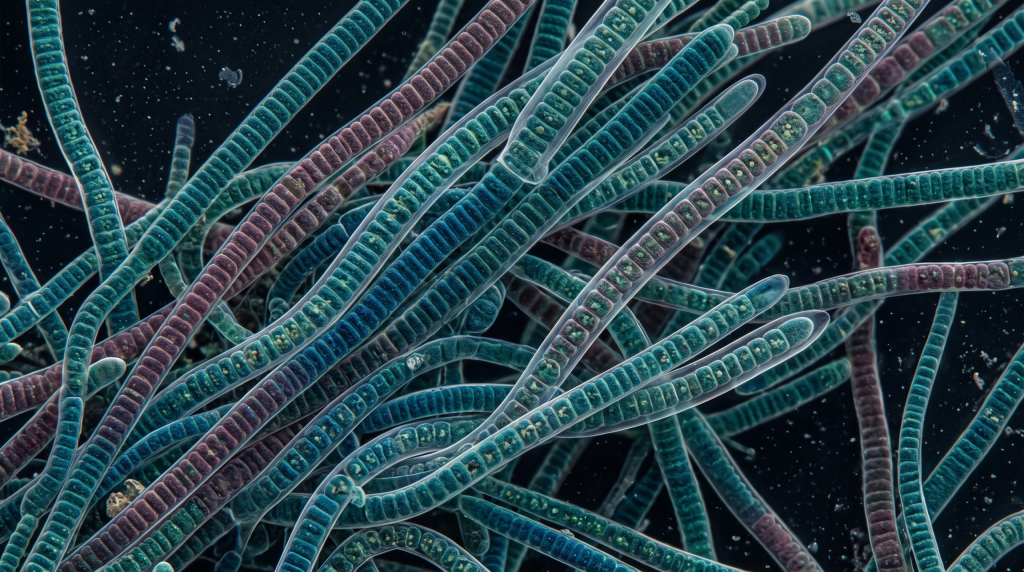
Cyanobacteria form cohesive mucilaginous sheets that detach in pieces, with trapped bubbles and an unpleasant smell. Diatoms are powdery and dissolve at the slightest movement, mat algae are fibrous and anchored. Under the microscope cyanobacteria show filaments of stacked cylindrical cells.
Practical boxes
The key numbers and signs
- Mucilaginous consistency that detaches in sheets, not fibrous
- Oxygen bubbles trapped in the mat
- Smell of wet earth, mud or acetone
- Variable colour, from red to green to purple, not reliable for identification
- Typical starting zones: substrate, low-flow corners, back of the rocks, sump
- Recurring favourable condition: low NO3 with PO4 available
Step-by-step operational protocol
- Daily manual removal with a siphon
- Cutting off the fuel: less food, siphoning of the detritus, cleaning of the filter
- Nutritional rebalancing: raise the nitrates if deficient, manage the phosphates towards stable values
- Correction of the flow in the dead zones and improvement of the oxygenation
- Reinforcement of the biological competition: plants in freshwater, refugium macroalgae in marine, beneficial bacteria
- Check of the source water with RO/DI and monitoring of the TDS
- Replacement of the lamp if aged
Mistakes that bring cyanobacteria back
- Using antibiotics as a first move instead of as a last resort
- Pursuing zero nutrients believing that it is equivalent to health
- Treating the symptom and ignoring the underlying imbalance
- Repeating the blackout at very short intervals
- Leaving the aerator switched on for ever in freshwater, degassing the plants’ CO2
- Expecting the UV lamp to solve a benthic mat
- Never replacing the lamp because “it still illuminates”
Glossary
Prokaryote: organism with a cell lacking a nucleus and internal organelles, like bacteria and therefore cyanobacteria.
Eukaryote: organism with a cell equipped with a nucleus and organelles, like algae, plants and animals.
Oxygenic photosynthesis: process that converts light, water and carbon dioxide into energy with production of oxygen. Cyanobacteria are the only prokaryotes to carry it out.
Phycobiliproteins: accessory pigments of cyanobacteria. Phycocyanin is blue, phycoerythrin is red, and their ratio determines the colour of the mat.
Biofilm: bacterial community organised in a gelatinous matrix adhering to the surfaces, that is the mat visible in the tank.
Diazotrophy: capacity to fix dissolved atmospheric nitrogen, transforming it into usable forms.
Nitrogenase: enzyme that carries out nitrogen fixation. It is inactivated by oxygen, which is why it works in the anoxic micro-zones of the mat.
DOC: Dissolved Organic Carbon, the dissolved organic matter deriving from food, excrement and decomposing material, the main fuel of cyanobacteria.
NO3 and PO4: nitrates and phosphates, the two key nutrients. Their imbalance, with scarce nitrogen and available phosphorus, favours cyanobacteria.
Redfield ratio: oceanic reference proportion between nitrogen and phosphorus in plankton, about 16 to 1. Useful as a concept, not as a dogma to be pursued in an aquarium.
Blackout: period of total darkness to deprive cyanobacteria of the light necessary for photosynthesis.
Hydrogen peroxide: oxygenated water, oxidising agent used empirically against cyanobacteria, with caution and real risks.
Erythromycin: macrolide antibiotic that blocks bacterial protein synthesis. Effective but harmful also to the nitrifying flora.
Cyanotoxins: toxins produced by some cyanobacteria, among them microcystin, anatoxin and saxitoxin.
Refugium: compartment connected to the tank in which macroalgae are cultivated to stabilise the nutrients and increase the biological competition.
Dry rock: sterile rock devoid of life, which in the first weeks releases compounds and favours bacterial colonisations.
Dead zone: area of the tank where the flow does not reach and the water stagnates, ideal environment for cyanobacteria.
RO/DI: reverse osmosis plus deionisation, the system that produces water practically free of dissolved salts for aquariums.
TDS: Total Dissolved Solids, the total concentration of dissolved solids in the water, measured in parts per million.
Article edited by Francesco Avezzano, journalist on the Italian pubblicista register with the Order of Journalists of Campania, scientific and technological populariser in the aquarium sector, founder of AquariumClick and Coralia Lab.
Share questo articolo:
Text reviewed by a human editor before publication. Editor responsible: Francesco Avezzano, a journalist registered with the Order of Journalists of Campania. How I use artificial intelligence