Calcium Reactor for Marine Aquariums
 Immagine generata con intelligenza artificiale
 Pros, Cons and Technical Advice
Introduction
When we talk about marine aquariums, especially those rich in stony corals such as Acropora, keeping water chemistry stable becomes an absolute priority. Calcium, carbonates and magnesium must be replenished constantly, otherwise growth slows down, tissues recede and the whole system can go out of balance.
The calcium reactor is one of the most reliable instruments for this purpose. It provides a continuous and automatic supply of calcium and KH, adapting perfectly to the needs of SPS-dominant tanks. But, like every technical solution, it has its positive and negative sides.
This guide analyses clearly and in detail how a calcium reactor works, what advantages it offers, when it is worth using and how it compares with other replenishment methods such as Balling, kalkwasser or automatic dosing pumps. You will also find a comparison between brands, guidance on adjustment and practical advice for avoiding the most common mistakes.
1. What a calcium reactor is
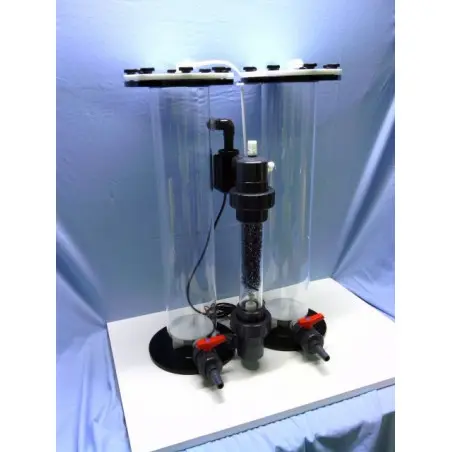
The calcium reactor is a closed system that uses CO₂ to dissolve calcareous material (such as aragonite or calcite) and release calcium and carbonates in soluble form. The fluid rich in these elements, called effluent, is then reintroduced into the aquarium.
How it works, in brief:
- Water is drawn from the aquarium.
- CO₂ is injected inside the reactor, lowering the pH.
- The calcareous material dissolves.
- The effluent (water enriched with Ca and KH) returns to the tank.
Main results:
- Stable increase in calcium (Ca²⁺)
- Constant replenishment of alkalinity (KH)
- Possible release of magnesium (if dolomite is used in the material)
2. Advantages and disadvantages of the calcium reactor
Advantages
- Chemical stability: it guarantees a continuous and balanced supply of Ca and KH, reducing peaks.
- Contained costs over time: the reactive material lasts months, even years, with little maintenance.
- Complete automation: it works 24 hours a day with minimal intervention, once calibrated.
- Excellent for tanks with high consumption: perfect for reefs with many SPS and high demand.
Disadvantages
- High initial investment: a reactor, CO₂ cylinder, regulator, solenoid valve and pH controller are needed.
- Adjustment is not trivial: the initial calibration requires time, patience and a certain amount of experience.
- Risk of overdosing: if set up badly, it can lower the pH in the tank too much.
- Trace elements less controllable: compared with the Balling method, it is harder to dose specific elements.
3. Reactor vs Balling, Balling Light, kalkwasser, automatic dosing pumps
Comparison between the main replenishment systems
| System | Ca | KH | Mg | Trace elements | Initial cost | Long-term cost | Automation |
|---|---|---|---|---|---|---|---|
| Reactor | ✓✓ | ✓✓ | ✓* | No | High | Low | ✓✓ |
| Classic Balling | ✓✓ | ✓✓ | ✓✓ | ✓ | Medium | Medium-high | ✓ |
| Balling Light | ✓✓ | ✓✓ | ✓ | ✓ | Medium | Medium | ✓ |
| Kalkwasser | ✓ | ✓ | No | No | Low | Low | Limited |
| Multiple dosing pumps | ✓ | ✓ | ✓ | ✓ | Medium | Medium | ✓✓ |
(*) Magnesium is replenished only if the calcareous material contains dolomite.
4. In which tanks it is worth using a reactor
- SPS-dominant:
It is the ideal solution. It offers continuity and precision. Perfect for Acropora and stony corals with high demand. - Mixed tanks:
It is useful, but often oversized. As an alternative, Balling Light or dosing pumps are more flexible. - ULNS / Zeovit systems:
Very precise control is needed, but a well-calibrated reactor can work well. - Methodologies such as Triton or Modern Reef:
They require very precise dosing of trace elements. The reactor can be integrated for Ca and KH, while the rest must be dosed separately.
5. Comparison between brands and models
| Brand | Build quality | Price | Volume supported | Notes |
|---|---|---|---|---|
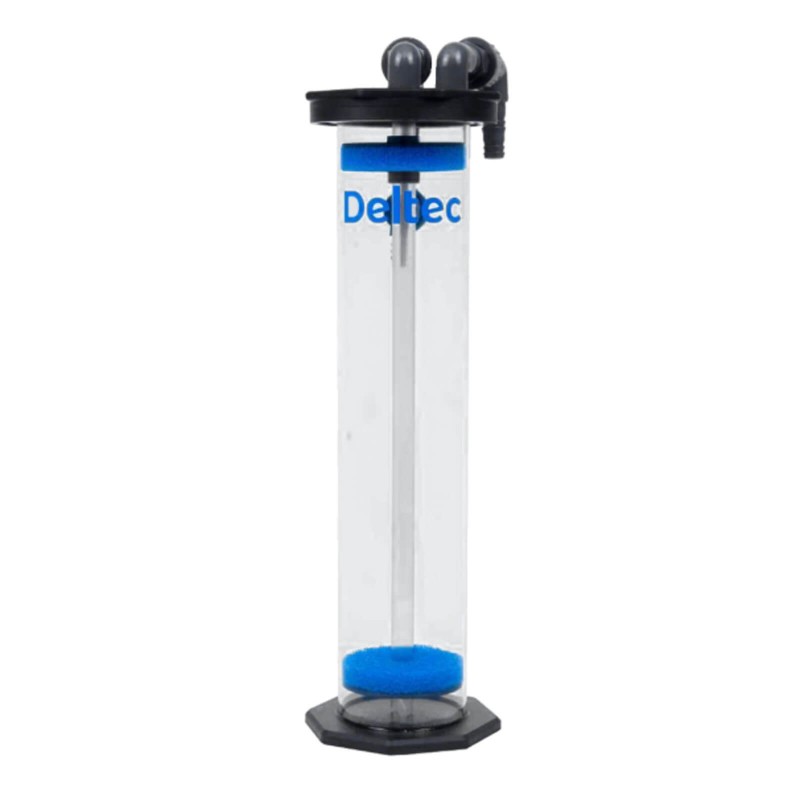
| Deltec | Excellent | High | Medium-large | Quiet, durable |
| AquaMedic | Good | Medium | Medium | Good value for money |
| Skimz | Medium | Medium-low | Medium | Compact, easy to install |
| Dastaco | Very high | Very high | Large | Advanced electronic control |
| Pacific Sun | Excellent | High | Medium-large | Modern design, app management |
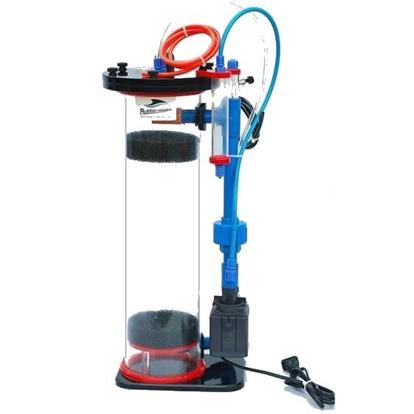
| Bubble-Magus | Medium | Low | Small-medium | Inexpensive but functional |



6. Fundamental technical aspects
- pH calibration:
It must be kept between 6.2 and 6.5, depending on the material used. If it drops too low, there is a risk of dissolving too much material and lowering the pH of the tank. - Type of calcareous material:
- Aragonite → more soluble, suitable for higher pH
- Calcite → less soluble, requires lower pH
- Dolomite → useful for also replenishing magnesium
- Effluent flow rate:
It must be constant. It is advisable to check the KH of the effluent regularly. - Peristaltic pumps:
Useful for guaranteeing a constant and reliable flow over time.
7. Common risks and prevention
- Carbonate precipitation:
Avoid excessive dosing. Always check the pH inside the reactor. - Lowering of the pH in the tank:
- Use a well-aerated sump
- Insert a degassing chamber after the reactor
- Reduce CO₂ during the night
- Effluent too concentrated:
The KH of the effluent should be > 30 dKH. If it exceeds this threshold, consider lowering the dosage. - Poor maintenance:
- Clean the reactor every 1–2 months
- Replace the calcareous material every 6–12 months
8. Costs: comparison over time
Cost trend (reactor vs Balling):
| Month | Reactor (€) | Balling (€) |
|---|---|---|
| 0 | 700 | 200 |
| 6 | 720 | 350 |
| 12 | 740 | 500 |
| 18 | 760 | 650 |
| 24 | 780 | 800 |
- The reactor costs more at the beginning, but over time it becomes much more economical.
- Balling has lower initial expenses, but the consumables weigh in over the long term.
9. Conclusion
The calcium reactor is a powerful instrument for those seeking stability, automation and long-term sustainability, especially in tanks with a high SPS load. It is neither the simplest solution nor the cheapest at the beginning, but once set up correctly it offers excellent performance.
If you manage a mixed tank, or if you want more detailed control over trace elements, you might prefer a hybrid or modular system such as Balling Light or Triton. As always in the aquarium hobby, the choice depends on your type of tank, on your experience and on the time you want to devote to maintenance.
Glossary
- KH: degree of alkalinity, expressed in dKH
- SPS: small-polyp stony corals (e.g. Acropora)
- Effluent: liquid rich in Ca and KH that comes out of the reactor
- ULNS: ultra-low nutrient systems (e.g. Zeovit)
- pH: index of acidity, regulates the solubility of carbonates
Information boxes
⚠ pH problems with the reactor?
- Increase aeration in the sump
- Use a degassing chamber
- Set a night-time timer to reduce CO₂
🔍 Recommended weekly checks:
- pH inside the reactor
- KH of the effluent
- Ca and KH levels in the tank
FAQ
Can I use a reactor in an LPS tank or with soft corals?
Yes, but often it is excessive. In these cases, Balling Light or dosing pumps offer more control and are more proportionate.
How often should maintenance be carried out?
Check the parameters every week. Clean the reactor every 1–2 months and replace the material every 6–12 months.
Is a pH controller absolutely necessary?
It is not compulsory, but it is highly recommended. It avoids serious mistakes and keeps everything stable.
For a 500-litre SPS tank, is a reactor or Balling better?
A reactor, without doubt. At the beginning it costs more, but it offers more stability and less maintenance over time.
Share questo articolo:
Text reviewed by a human editor before publication. Editor responsible: Francesco Avezzano, a journalist registered with the Order of Journalists of Campania. How I use artificial intelligence