Amblyglyphidodon aureus: technical profile
Introduction 🌊
Amblyglyphidodon aureus is a fish of the Pomacentridae family that brings into the tank a note of bright colour and constant movement. Widespread in the coral reefs of the Indo-Pacific, it is appreciated for its luminous appearance and for its capacity to adapt to different aquarium contexts, while maintaining a certain degree of territoriality, especially in reduced spaces.
Although it belongs to the damselfish, a group famous for its lively disposition, this species is less aggressive than others of its kind, which makes it manageable even in mixed reefs if introduced correctly and with an adequate availability of hiding places.
Common name
- Golden damselfish
- Yellow damselfish
- In English: Golden damselfish
Synonyms
- Chrysiptera aurea (obsolete use)
- No scientific synonym currently valid besides the original name
Morphology 🔬
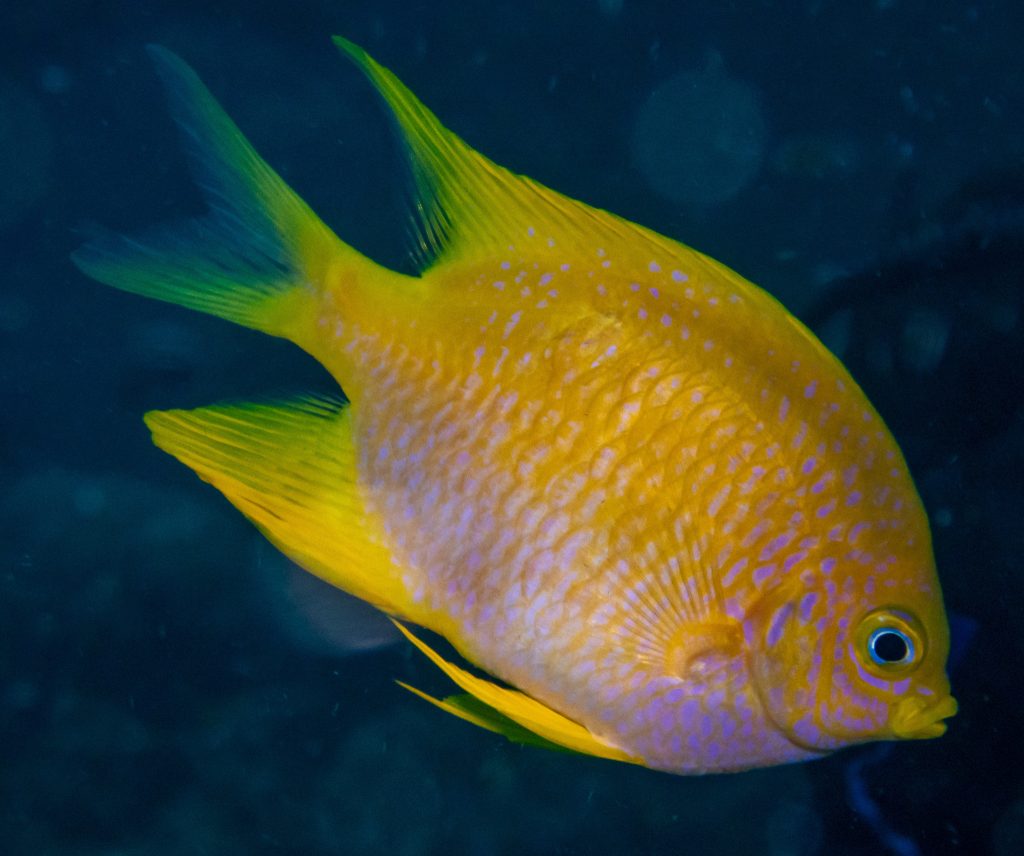
Oval body, laterally compressed, typical of the Pomacentridae, with uniform golden yellow colouring over the whole body and the fins. The livery is intense and homogeneous, without spots or bands, a distinctive characteristic compared with other damselfish.
Dorsal and anal fins with spiny rays followed by soft rays; caudal fin forked and translucent. Eye in proportion, with a yellow-orange iris.
The skin is covered with small cycloid scales, which give it a velvety appearance under LED light.
Differences between males and females
Minimal sexual dimorphism:
- Males slightly larger and sometimes more intensely coloured in the reproductive period.
- Females with a more rounded abdomen in the phase of sexual maturity.
The sex is difficult to identify without observation of the reproductive behaviour.
Way of life
In nature it lives in small groups or pairs, often near coral branches or rocky formations with crevices. It shows sedentary and territorial behaviour, defending a small area but with vigour.
It feeds predominantly on zooplankton and small invertebrates suspended in the water column, alternating short chases with moments of stationing close to its refuge.


Territoriality ⚠️
Moderate. More peaceful than many damselfish, but it actively defends its own space from conspecifics and fish similar in shape and diet, especially in small tanks.
Life expectancy
In the aquarium, with good care, it can live up to 6–8 years.
Maximum size
Maximum recorded length: 8 cm.
Description
A fish of medium size for the damselfish group, entirely golden yellow, elegant in appearance and with high hardiness. Its colouring, stable over time, makes it much sought after in reef tanks for chromatic contrast with corals and other species.
Status on the IUCN red list
Habitat – origin and geographical distribution 🌍
Present in a large part of the Indo-Pacific: Thailand, Indonesia, the Philippines, Papua New Guinea, Palau, the Solomon Islands and the Australian Great Barrier Reef. It lives between 5 and 25 metres of depth on fringing coral reefs and sheltered slopes.
Temperature in nature
Between 25 and 28 °C, with minimal seasonal variations.
Environmental parameters: nature vs aquarium
- Nature: salinity 35‰, pH 8.1–8.4, KH 7–9
- Aquarium: salinity 34–35‰, pH 8.0–8.3, KH 7–9, temperature 25–26 °C, nitrates <15 ppm, phosphates low but present
Keeping in the aquarium
It requires:
- A well-matured tank, with rockwork and shaded zones
- Moderate current
- Medium or intense lighting (not critical for the fish, but for the reef)
- Stable water of good quality
Minimum dimensions of the aquarium
At least 150 litres for a small group, 80–100 litres for a single specimen.
Minimum population in the aquarium
It can be kept singly, in a pair or in small groups (only in large tanks in order to reduce conflicts).
Compatibility with other species 🤝
Compatible:
- Clownfish (Amphiprion spp.)
- Peaceful gobies and blennies
- Cardinalfish (Pterapogon spp.)
- Peaceful wrasses of small size
- Non-predatory invertebrates
Not advisable:
- Other aggressive Pomacentridae
- Butterflyfish that prey on polyps
- Excessively active wrasses that may stress it
Feeding in nature and in the aquarium 🍽️
In nature: zooplankton, small crustaceans, invertebrate larvae, sometimes filamentous algae.
In the aquarium: mysis, enriched artemia, copepods, protein micro-granules, high-quality flakes. 2–3 meals a day.
Reproductive behaviour
Oviparous species: the male prepares a substrate and courts the female. The adhesive eggs are laid on rock or dead coral and guarded by the male until hatching (3–5 days).
Protection of the fry
The larvae are pelagic and disperse in the water column, requiring particular conditions for survival in captivity.
Risks of hybridisation
Low, given the chromatic and behavioural difference from related species.
Hardiness 💪
A very hardy fish, suitable even for newcomers to marine tanks, provided the parameters and the minimum space are respected.
Lighting in the aquarium 💡
It has no specific light requirements, but it adapts well both to the intense lighting typical of SPS tanks and to more moderate conditions.
Current in the aquarium 🌬️
Moderate, with refuge zones.
Availability in the trade 🛒
Relatively common in specialist shops. Average price: 20–35 €.
Pros and Cons
Pros:
- Lively and stable colour
- Hardy and easy to feed
- Suitable for mixed reefs
Cons:
- It can become territorial in reduced spaces
- Not always compatible with other damselfish
Practical BOXES – Technical guide 🧰
| Parameter | Recommended value |
|---|---|
| Temperature | 25–26 °C |
| Salinity | 1.024–1.025 |
| pH | 8.0–8.3 |
| KH | 7–9 dKH |
| Minimum litres | 80 single, 150+ group |
| Compatibility | High with peaceful fish |
| Current | Moderate |
| Lighting | Medium-high |
| Diet | Opportunistic carnivore |
| Price | 20–35 € |
FAQ – Frequently asked questions 🧠
Is it aggressive?
Moderately, above all towards conspecifics.
Can it be kept in a group?
Yes, but only in large tanks.
Does it eat dry food?
Yes, if of good quality.
Compatible with corals?
Absolutely yes.
Is it suitable for beginners?
Yes, among the damselfish it is one of the most manageable.
Conclusion
Amblyglyphidodon aureus combines aesthetics and hardiness, bringing into the tank the charm of a brilliant yellow and behaviours typical of the Pomacentridae. In attentive hands, it can become a stable and peaceful element of colour in the domestic reef, offering movement and vitality without compromising coexistence with other species.
Share questo articolo:
Text reviewed by a human editor before publication. Editor responsible: Francesco Avezzano, a journalist registered with the Order of Journalists of Campania. How I use artificial intelligence