Amblyeleotris steinitzi: technical profile
Introduction 🌊
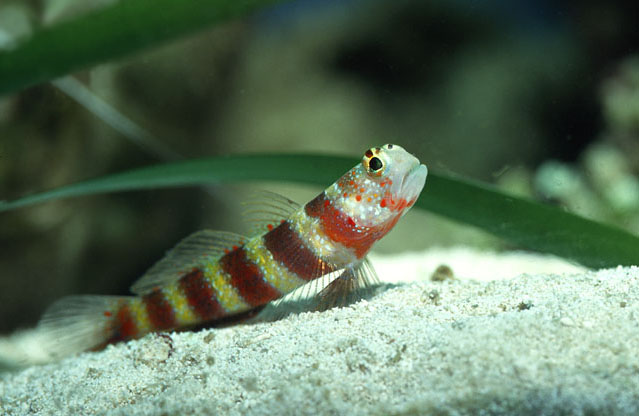
If you love intelligent behaviours, Amblyeleotris steinitzi is a fish that forces you to slow down. You watch it, and you realise it does nothing by chance. It is a sentinel goby that lives in mutualistic symbiosis with alpheid shrimps (Alpheus spp.). The pact is clear: the shrimp digs and maintains the burrow, the goby keeps watch. They communicate by contact, with the shrimp’s antennules resting on the goby’s flank, while the latter “speaks” with micro-movements of the tail. When something is not right, they both dart back in at once. It is a micro-choreography of trust and specialisation that in the aquarium becomes a daily spectacle.
From an ecological point of view, A. steinitzi occupies sandy or detrital microhabitats at the edges of the reef, where the burrow offers protection and a lookout point. In the tank it mimics the same pattern. If you give it fine sand, well-stable rocks and a compatible alpheid shrimp, the pair forms and gets to work. If you remove one of these pillars, the arrangement breaks down and problems begin: stress, fasting, escape. This guide was written to spare you those, with technical, realistic and verifiable indications.
Common name
Steinitz’s goby, sentinel goby, in English Steinitz’s prawn goby. In aquarium circles you will also hear it called symbiotic goby.
Synonyms
There are no currently valid scientific synonyms. In the past it has sometimes been confused with other congeners with a banded pattern, which has produced improper citations in the grey literature. For the set-up you are interested in, aim at the valid name: Amblyeleotris steinitzi.
Morphology 🔬
Body elongated and slightly compressed, musculature ready to dart, fused ventral fins forming an adhesive disc to anchor itself to the sand. Broad head, large dorsal eyes that guarantee a panoramic field of view while it stays “mid-air” over the entrance.
The livery shows transverse bands from ivory to hazel-orange, often 5–7 bands with soft margins. The first dorsal is relatively low, the second longer and more “elastic” in its fluttering. Rounded caudal fin, useful for backward darts towards the burrow. Sub-terminal mouth, fine dentition, perfect for microcrustaceans and zooplankton near the bottom. Backlit by LEDs, pearly speckling appears on the unpaired fins.

Differences between males and females
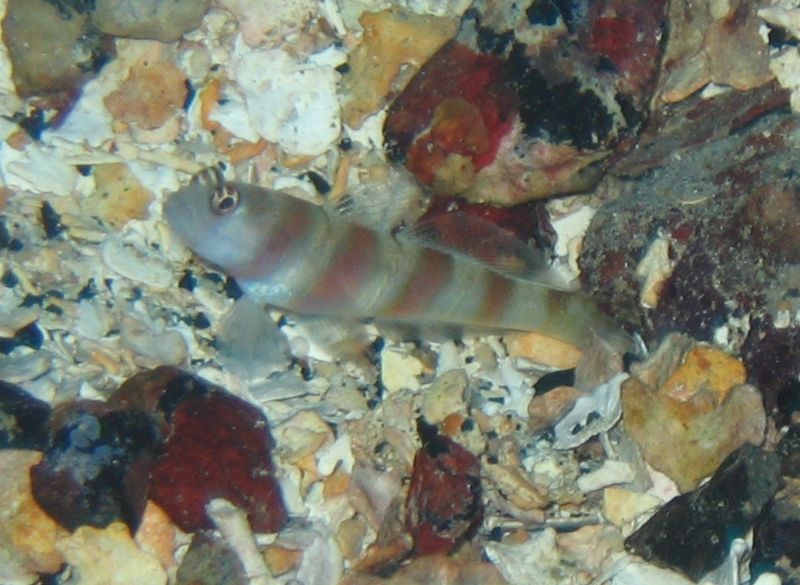
Slight dimorphism. On average:
- Males slightly more robust, second dorsal sometimes more pronounced, a more “wary” attitude in defence of the burrow.
- Females with a fuller abdomen around ovulation, band shading sometimes less contrasted.
In practice, in the shop they are hard to sex. The pair is recognised more by behaviour than by appearance.
Way of life
A strictly benthic species. It stays a few centimetres from the entrance, with short sorties to catch micro-prey in suspension. It maintains continuous contact with the shrimp’s antennae. If the flow shifts the sand or a snail obstructs the entrance, you will see it restore the opening with its body while the shrimp moves the sediment from the inside.
In stable conditions, it alternates lookout stationing, micro-foraging and rapid retreats. In a new tank or with too much frenzy from tankmates, its shyness increases and it tends to jump if frightened. Always a lid.
Territoriality ⚠️
Moderate, but specific. It defends the burrow from other symbiotic gobies or from fish looking for the same refuge. With species that do not compete for the microhabitat it is peaceful. In small tanks, two goby+shrimp pairs come into conflict. In long tanks, with several distant sandy areas and separate burrows, coexistence is possible.
Life expectancy
3–5 years in the wild. In the tank 5–7 years if the parameters are stable, the diet varied and the symbiosis maintained. The factor that most often shortens life is chronic stress from disturbance of the burrow or osmotic swings.
Maximum size
Generally 8–10 cm. Well-conditioned specimens can reach 11 cm. A useful size for a nano reef with wide sandy surfaces.
Description
On the reef it looks discreet but elegant. The transverse bands break up and close again according to the angle of the light. The typical posture is oblique over the entrance, caudal fin vibrated in pulses when it “speaks” to the shrimp. The charm is not the flashy livery, it is the attitude.
Status on the IUCN red list
Currently Amblyeleotris steinitzi is classified as Least Concern (LC), that is at minimal risk, thanks to its wide distribution and its good capacity for adaptation. However, the degradation of coral habitats and excessive collection for the local aquarium trade in some areas represent potential threats.
Habitat – origin and geographical distribution 🌍
Western Indo-Pacific with a solid presence in the Red Sea and in the Gulf of Aden, records along the East African belt, as far as Oman and the Maldives. The microhabitat is sandy or detrital at the margin of the coral reef and in sheltered lagoons, often with fragments of dead coral useful as the lintel of the burrow. Typical depth 3–20 m, with observations beyond that too, where the light is diffuse and the current is gentle.
Temperature in the wild
Stable tropical waters: 24–28 °C. Limited daily excursion. In the tank, stay at 25–26 °C to minimise metabolic stress and maintain appetite.
Environmental parameters: the wild vs the aquarium
- Salinity: in the wild ~35‰, in the tank 34–35‰.
- pH: in the wild 8.1–8.4, in the tank 8.0–8.3.
- KH: 7–9 dKH.
- Oxygen: high, flow not directed at the opening.
- Substrate: fine sand 1–2 mm, with a few pebbles or pieces of skeleton to consolidate the roof of the burrow.
Keep nutrients low and stable. Nitrates <10 ppm, phosphates in traces useful to the microfauna but not in excess.
Keeping in the aquarium
Give it what it needs and it works. In short:
- Fine sand at 4–6 cm. If you want to see the building site at work, take it to 5–7 cm in the dedicated area.
- Solidly anchored rocks. The collapse of the rockwork is the kryptonite of every goby-shrimp symbiosis.
- Compatible alpheid shrimp. See below.
- Closed tank. It is a jumper.
- Moderate lighting with lateral shade.
- Indirect flow near the burrow.
Introduction: acclimatise slowly, low lights, visual screens for the first 24 hours. If you already have the shrimp, you will see the pairing within 1–3 days. If you introduce the goby first, the arrival of the shrimp can unlock shyness and appetite.
Minimum aquarium size
80 litres for one pair of goby+shrimp in a dedicated tank. In a mixed reef I would consider 100–150 litres because you need free sandy surfaces, quiet corners and room for the other fish. Two pairs require a long tank and distant burrows.
Minimum population in the aquarium
One goby + one shrimp is the formula that always works. Two gobies? Only a sexed pair and a suitable tank. More than one pair in the same small tank creates competition and stress for the shrimp.
Compatibility with other species 🤝
Compatible, recommended
- Clownfish Amphiprion ocellaris, A. percula and related, non-dominant specimens.
- Gramma loreto and Gramma melacara, respectful of other animals’ territory.
- Cardinalfish Pterapogon kauderni, Sphaeramia nematoptera.
- Non-symbiotic gobies of small and peaceful size, for example Trimma and Eviota in large tanks.
- Dartfish Nemateleotris magnifica, N. decora if the aquarium has several burrows.
- Peaceful invertebrates: Lysmata spp., Thor amboinensis, small Hermits, Trochus, Nassarius.
- Corals, soft and moderately growing LPS. Avoid covering the entrance with invasive colonies.
At risk or not recommended
- Aggressive Dottyback/Pseudochromis, they prey on small gobies.
- Hawkfish Cirrhitidae, opportunistic predation.
- Large active wrasses of the Thalassoma type, they stress the fish and disturb the burrow.
- Predatory lionfish/groupers.
- Large sand-sifting gobies, for example Valenciennea spp., which collapse the burrows.
- Predatory crabs and mantis.
Compatible alpheid shrimps
Alpheus ochrostriatus, A. randalli, A. djeddensis are frequently accepted. Alpheus bellulus also works in many tanks. The harmony is not mathematical, but pairing with these taxa is statistically solid.
Feeding in the wild and in the aquarium 🍽️
In the wild: benthic microcrustaceans, copepods, amphipods, crustacean larvae, zooplankton carried at low level. It hunts by short ambush, with rapid darts a few centimetres from the entrance.
In the aquarium: focus on mysis and enriched brine shrimp, frozen copepods and calanus, slow-sinking micro-granules for carnivores. Products that work well: Liquid Mysis and Liquid Artemia Aquaforest, DKI and Easy Masstick Easy Reefs, Hikari Marine S in micro-granules, fine calanus pulps.
Frequency: 2–3 small meals a day. Distribute near the burrow with a pipette or lateral flow. In a pair, the shrimp collects part of the food; that is not a problem, it is part of the symbiotic package.
Tip: if a newly introduced specimen refuses dry food, unlock it with live food: brine shrimp nauplii, live copepods, marine blackworms if available.
Reproductive behaviour
In the tank it is rare, but it is worth knowing about. Courtship includes vibrations of the dorsal, rubbing on the opening, alternating entries and exits from the burrow. The adhesive eggs are laid inside, on a ceiling cleaned by the shrimp. The male tends to aerate the interior with movements of the pectoral, but both adults defend the access. Hatching in 2–4 days depending on temperature. The larvae are pelagic, tiny and extremely difficult to manage in hobby conditions.
Protection of the fry
Parental care essentially ceases at hatching. To attempt larval rearing you need a separate nursery tank, quality phytoplankton and rotifers, subdued light and laboratory-grade management. For a standard home reef it is not a realistic objective.
Hybridisation risks
Irrelevant in practice. In mixed tanks with other similar Amblyeleotris you may observe opportunistic matings, but there are no established lines in the hobby. If you care about specific purity, avoid cohabitation with morphologically related congeners.
Hardiness 💪
Hardy if you give it stability. Fragile if you get acclimatisation and salinity wrong. Typical critical issues:
- Cryptocaryon irritans in stressed subjects.
- Osmotic swings during top-ups and water changes.
- Burrow collapse due to sifters or badly positioned pumps.
Best practice: quarantine the fish in a separate tank with mature filtration; if you treat parasites use protocols targeted at the fish and do not house invertebrates in the QT. In the main tank avoid copper and reef-unsaf e medications.
Lighting in the aquarium 💡
It is not a light-lover. Stay on moderate intensities with shaded areas. In bright SPS reefs, create visual tunnels and recesses; that way the goby stays exposed without feeling like a victim.
Current in the aquarium 🌬️
Moderate, diffuse. Avoid direct jets on the opening, which cause collapses. Lateral flows with soft returns maintain oxygenation without weakening the structure of the burrow.
Availability on the market 🛒
Fairly common in shops specialising in marine. Sometimes it arrives in a pair with Alpheus. Average European prices: 35–70 € for the goby, 70–120 € for an established pair. Assess nutritional state (belly not sunken), regular breathing, responsiveness to the environment.
Pros and Cons
Pros
- Symbiotic behaviour of high educational and scenic value.
- Contained size, usable even in well-designed nano reefs.
- Flexible diet after adaptation.
- Compatible with many peaceful species and with corals.
Cons
- A functioning symbiosis is necessary for full well-being.
- Jumper when frightened, a lid is needed.
- Sensitive to osmotic swings and to burrow collapses.
- Complex reproduction.
- With other similar gobies it can be competitive over the microhabitat.
Practical BOXES – Essential technical procedures 🧰
Burrow area set-up
- Sand 1–2 mm, thickness 5–7 cm in at least 1/3 of the tank.
- Insert pebbles or skeleton branches for stable roofs.
- Flow direction lateral, not frontal.
Pairing with the shrimp
- Recommended shrimps: Alpheus ochrostriatus, A. randalli, A. djeddensis, A. bellulus.
- Introduce the shrimp first, then the goby with low lights.
- Do not disturb the area for 72 hours.
Practical feeding
- 2–3 small meals a day.
- Start with mysis and enriched brine shrimp, then micro-granules.
- Administer by pipette near the burrow.
Parameter control
- Temperature 25–26 °C, salinity 1.024–1.025, pH 8.0–8.3, KH 7–9.
- Nitrates <10 ppm, phosphates low and stable.
Emergency management
- Jumped out: cover the tank, stay calm, reduce the lights, put it back in with drip acclimatisation.
- Collapsed burrow: redirect the pumps, add sand and a support at the entrance, let the shrimp work.
- Loss of appetite: try live copepods or nauplii for 3–5 days, then go back to frozen food.
FAQ – Frequently asked questions from the community 🧠
Is the shrimp absolutely necessary?
Yes for natural behaviour and psychological stability. Without a shrimp it often stays hidden, eats little, jumps more easily.
Which shrimp is the “easiest”?
Alpheus ochrostriatus and A. randalli show very frequent pairing with A. steinitzi. Every individual has preferences, but the odds are good.
Can I keep two of them in 100 litres?
Two symbiotic gobies in 100 litres is risky. Unless the tank is long with distant burrows, one single goby+shrimp pair is better.
Is a Valenciennea sifter a problem?
Yes. Valenciennea often collapse the burrows. Not a recommended choice in the same compartment.
Does it get on with clownfish?
With non-dominant Amphiprion, usually yes. Avoid very territorial adult pairs in small tanks.
Does it only eat live food?
During the adaptation phase it may prefer live food. With patience it moves on to mysis, enriched brine shrimp, calanus, then micro-granules.
Can it live in a 60-litre nano?
Possible in a dedicated set-up, with a lid and one single calm tankmate. For a mixed reef 80–100 litres is better.
I have 3–5 mm sand, is that all right?
It works less well. It prefers 1–2 mm. If you do not want to replace it, create a pocket of fine sand in the burrow area.
How often should I siphon the sand?
Little and laterally. Avoid dismantling the opening. Better a targeted change and perimeter maintenance.
Why does it disappear when the lights are high?
It does not like glare. Offer shade and refuges; it will go back to guarding the threshold.
Conclusion
Amblyeleotris steinitzi is an invitation to design the aquarium with intention. It is not enough to “put it in the tank”. It needs the right sand, a stable architecture, a respectful flow and above all a reliable alpheid shrimp. In exchange, it gives you pure ethology a metre from your eyes. It is reef biology compressed into a few centimetres, every day, with no special effects.
If you are looking for a “simple and noisy” fish, it is not the one. If you want natural behaviours, subtle balances and a project that grows over time, then yes, it is the right choice. Take care of stability, protect the burrow, feed little and often. The rest they will do themselves, with a language made of sand that moves and tails that talk.
Share questo articolo:
Text reviewed by a human editor before publication. Editor responsible: Francesco Avezzano, a journalist registered with the Order of Journalists of Campania. How I use artificial intelligence